Abraham Mignon (Frankfurt, 1640 - Utrecht, 1679) was a Dutch still life painter of German origin. Although his life was short, his paintings of flowers, fruit and birds were sought after by collectors across Europe in the 17th and 18th centuries, among them Louis XIV of France and the Elector of Saxony.
His family, originally from Hainaut, settled in Frankfurt and later in Wetzlar. Around 1649 Mignon was placed in the care of Jacob Marrel, a flower painter and art dealer who trained him and left him to manage his business. By about 1659 the two had settled in Utrecht. There Mignon worked in the workshop of Jan Davidszoon de Heem, a leading innovator of still life, and probably took it over when De Heem returned to Antwerp in 1672. That same year he was elected deacon of the Walloon Church in Utrecht, a post he held for five years. In 1675 he married the daughter of the painter Cornelis Willaerts.
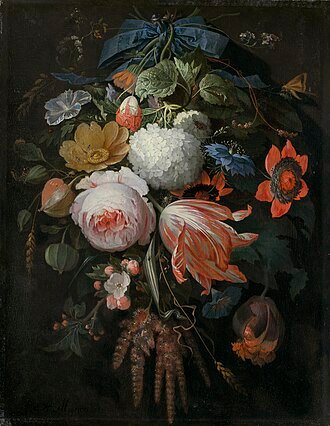
His style is marked by a careful finish and a delicate handling of flowers. He often placed red or white roses in the centre of the canvas and set the whole arrangement against a dark background. His palette favoured red, yellow and blue, and his treatment of nature is cooler and more distant than De Heem's. Major holdings include six paintings in the Louvre and four in the Hermitage, and the Dresden gallery, which owns fifteen of his works, twelve of them signed. He frequently included poppies as a reference to the transience of life, and his forest floor still lifes show the influence of Otto Marseus van Schrieck.
About four hundred still lifes are attributed to him, a figure that probably includes work from his workshop and from followers such as Jan Mortel, Conraet Roepel and Jacob Bart. His legacy lies in the wide circulation of Dutch flower painting and in the imitators his success attracted.
Works (7)


A still life dated 1675 and attributed to Abraham Mignon, a German painter known for floral and fruit still lifes. The record describes a composition centred on fruit, with a fish and a nest as additional elements. The arrangement follows the conventions of the genre, gathering abundant produce on a surface.

Still life by Abraham Mignon dated 1670 and held at the Hermitage. The composition is arranged on a forest floor, where fruit, a fish and a bird's nest are set out together, mixing items from nature with food. Mignon focuses on the texture of the surfaces and on colour contrasts between the fruit, the foliage and the fish. The record offers no further details about its commission or the specific meaning of the elements shown.

Still life by Abraham Mignon dated 1659, showing a fruit basket with a bird's nest set among the fruit. The scene pairs the still life genre with a small, everyday detail, inviting the viewer to look closely at the textures of the fruit and the light across the canvas. The available information does not allow more precise statements about its commission or reception.


This still life by Abraham Mignon, dated 1650 and painted in oil on canvas, gathers flowers and tiny creatures into an arrangement with a symbolic purpose. Its title, Vanitas, suggests that it probably invites viewers to reflect on the brevity of life and the fleeting nature of earthly pleasures, though little is known about who commissioned it.
Where to see the work
- Galería Nacional de Arte Washington, D.C. · 2
- Kabinet van Heteren Gevers · 1
- Hermitage Museum Saint Petersburg · 1
- Staatliche Kunstsammlungen Dresden Dresden · 1
- Schloss Wilhelmshöhe Kassel · 1
- National Museum in Warsaw Warsaw · 1
Teachers and pupils
Pupils
- Elias van den Broeck 1652–1708
Curiosities
A famous apprentice
Marrel asked Mignon to train his stepdaughter, Maria Sibylla Merian, daughter of the engraver Matthew Merian, in still life painting. She went on to achieve distinction as a flower painter, which shows the role that the Marrel and Mignon workshop played in shaping younger artists.
Undated works
Mignon never dated his compositions, which makes it very hard to establish a chronology for his output. Scholars rely mainly on stylistic judgement and consider his more elaborate still lifes, with clear colours, sharp focus and dark backgrounds, to be probably from around 1670, when he worked closely with De Heem.