
Adriaen Pietersz van de Venne (probably 1589 or 1590 to 1662) was a versatile Dutch Golden Age painter, working in allegory, genre and portraiture, and also active as a miniaturist, book illustrator, designer of political satires and versifier. His work reflects sharply the religious and social tensions of the Dutch Republic, and his interest in verse sets him apart from many of his contemporaries.
Born in Delft, he trained with the goldsmith and painter Simon de Valk and later learned engraving from Jeronimus van Diest, a painter of grisailles. Around 1614 he settled in Middelburg, close to the border that divided the Northern and Southern Netherlands along the Scheldt river, and there he came under the influence of Jan Brueghel the Elder and Pieter Brueghel the Elder. His painting Fishing for Souls (1614), now in the Rijksmuseum, is an ironic allegory of Catholic and Protestant fanaticism during the Eighty Years War, painted while the Twelve Years' Truce was in force.
From 1620 until his death he devoted himself to grisailles and genre prints showing peasants, beggars, thieves and fools that illustrated proverbs and sayings, often drawn from the writings of Jacob Cats. This output made him famous in his lifetime and kept him popular through the eighteenth century. After moving to The Hague, he joined the Guild of Saint Luke in 1625 and became its dean in 1637. He was also a founding member of the Confrerie Pictura, which sought to raise the social standing of the artist through a more academic approach to the arts. He died in The Hague in 1662.
His legacy rests mainly on the moralizing genre scenes that defined much of his reputation, and on his advocacy for the intellectual dignity of the painter.
Works (3)

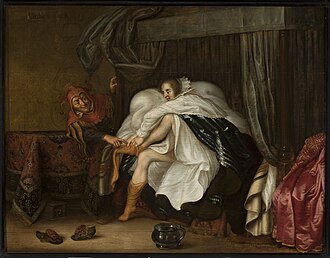
Painting by Adriaen van de Venne dated 1633, executed in oil on an oak panel. It shows a woman with a jester in a domestic interior, where everyday objects such as a chamber pot, stockings, a shoe and a bed hint at an intimate setting. Without further documentation, it is wise to read the scene cautiously, as its precise meaning remains open.

A small panel from 1615 in which painter Adriaen van de Venne depicts a winter scene, with skaters on a frozen expanse, a horse-drawn sledge and a castle in the distance. The record offers no further information about its commission or history, so it is best to rely on what the scene shows: everyday activity set against the white stillness of the ice, with the architecture receding toward the horizon.
Where to see the work
- Rijksmuseum Amsterdam · 1
- National Museum in Warsaw Warsaw · 1
- Worcester Art Museum Worcester · 1
Curiosities
Latin learned in Leiden
According to Houbraken, the eighteenth-century Dutch biographer, Van de Venne learned Latin in Leiden. This detail suggests a broader intellectual formation than was usual for a working painter, which fits with his later interest in verse and in satires carrying moral and literary content.
A 1652 scene in a private collection
Among his genre works is Where There Are People Money May Be Made, dated 1652 and held in a private collection. Its title, with its ironic reference to how easily crowds can be fooled, sums up the satirical tone of his later production and his critical view of everyday behaviour in Dutch society.