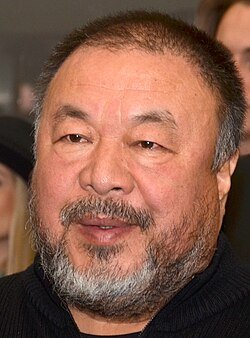
Ai Weiwei
1957– · Chinese contemporary artist, documentarian and activist
Ai Weiwei (born 28 August 1957 in Beijing) is a Chinese contemporary artist, documentarian and activist. His work and his public stance have made him one of the most visible figures in current Chinese art, at the intersection of artistic creation, architecture and political criticism.
The son of the poet Ai Qing, he grew up in harsh conditions in the far northwest of China. When he was one year old, his family was sent to a labour camp in Heilongjiang and, in 1961, exiled to Shihezi in Xinjiang, where they lived for sixteen years. The family returned to Beijing in 1976, after the end of the Cultural Revolution. In 1978 he enrolled at the Beijing Film Academy to study animation, and that same year he was one of the founders of the avant-garde group the Stars, which disbanded in 1983 although he continued to take part in its shows.
From 1981 to 1993 he lived in the United States, mostly in New York. There he studied at the Art Students League, made a living drawing street portraits, and encountered the work of Marcel Duchamp, Andy Warhol and Jasper Johns, which led him to make conceptual art by altering ready-made objects. During those years he photographed his surroundings in the East Village, and these images are now known as New York Photographs. He also befriended the poet Allen Ginsberg.
Back in China in 1993, he helped establish the Beijing East Village artists' group and co-published, with curator Feng Boyi, three books on the new generation of artists. In 1999 he built a studio house in Caochangdi, his first architectural project, and in 2003 he founded the FAKE Design studio. Earlier, as an artistic adviser, he had worked with the Swiss architects Herzog & de Meuron on the Beijing National Stadium for the 2008 Olympic Games.
As an activist, he has consistently criticised the Chinese government’s stance on democracy and human rights. After the 2008 Sichuan earthquake he investigated the collapse of schools and gathered the names of the children who died in what he called the Citizens’ Investigation, publishing the material on his blog, which was shut down in 2009. In April 2011 he was detained at Beijing Capital International Airport and held for 81 days without charge; officials referred vaguely to “economic crimes”.
Since 2015, when he recovered his passport, he has lived in Berlin, Cambridge and Portugal. His output includes political sculpture, photography and public works, and his recurring themes include freedom of expression and human rights. His legacy lies in having joined artistic practice and civic commitment within a context of strong political control.