
Alvan Fisher
1792–1863 · American landscape and genre painter
Alvan Fisher (Needham, Massachusetts, 1792 – Dedham, 1863) was one of the first American-born painters to specialise in landscape and genre subjects, themes that drew a wide audience in the young republic. He trained in Boston with John Ritto Penniman, learning portraiture while also decorating carriages and painting commercial signs.
From 1815 he kept a professional studio in Boston. He travelled across the northeastern United States in search of scenery, painted Niagara Falls after his visit there in 1820, and produced views of Harvard College that were later engraved for wide distribution. Between 1822 and 1823 he painted the racehorse American Eclipse several times. In 1825 he went to Europe, where he studied the work of Claude Lorrain and copied Old Masters at the Louvre. After returning in 1826 he opened a studio in Boston, and in 1827 he was named an Honorary Academician of the National Academy of Design.
His pictures were widely reproduced in gift books of the period, such as The Token, which broadened his popularity. Around 1840 he moved to Dedham, where he spent his last years and worked from a studio on his estate. He is remembered mainly as a pioneer of American landscape and genre painting; a century after his death, Jacqueline Kennedy chose one of his paintings for the Green Room of the White House.
Works (2)

This general view of Niagara Falls, dated 1820, places the waterfall at the centre of a landscape framed by tall vegetation and clouds. Painted in oil on canvas, it keeps the viewer at some distance, so the cascade blends with its natural surroundings. The available record offers no further details about its commission or reception.
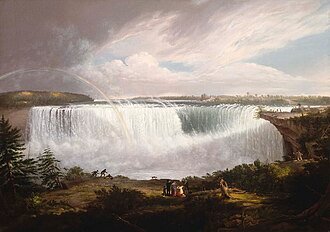
Oil on canvas dated 1820 by Alvan Fisher, showing the Horseshoe Falls of Niagara, one of North America's most famous waterfalls. A tree is listed as the main subject, suggesting that vegetation plays a notable role alongside the cascade. Without further documentation, the commission and circumstances of its making remain unclear.
Where to see the work
- Smithsonian American Art Museum Washington, D.C. · 2