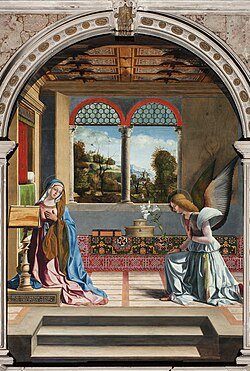
Andrea Previtali
1475–1528 · Italian Renaissance painter from Bergamo, trained in the workshop of Giovanni Bellini
Andrea Previtali (born in Berbenno, Bergamo, c. 1470, died 1528, with birth dates varying between sources) was an Italian Renaissance painter, also known as Cordeliaghi. He is remembered for combining a Venetian training with a body of work closely tied to Bergamo, his home city.
Born in a small town in the province of Bergamo, he went to Venice as a teenager and worked in the workshop of Giovanni Bellini. There he came into contact with Carpaccio, Giorgione and Palma il Vecchio, whose influence shows in his style. Around 1511 he returned to Bergamo, where his painting reflects the influence of Lorenzo Lotto.
Most of his output is devotional, alongside portraits noted for their realism and luminosity. Key works include the Casotti Sacra Conversazione in the Accademia Carrara, and the Salvator Mundi and The Virgin and Child with a Shoot of Olive, both in the National Gallery, London. His reputation was revived in the twentieth century, and his paintings remain in Italian and international collections.
Works (25)

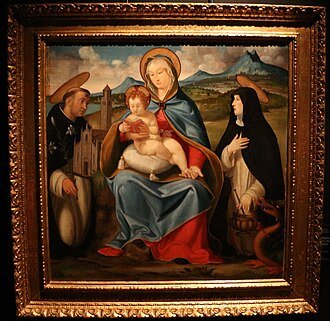


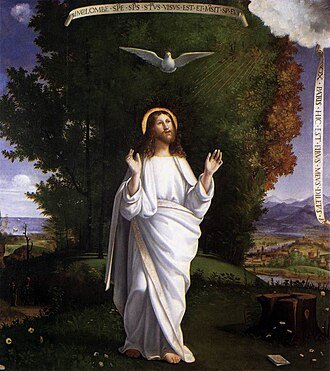


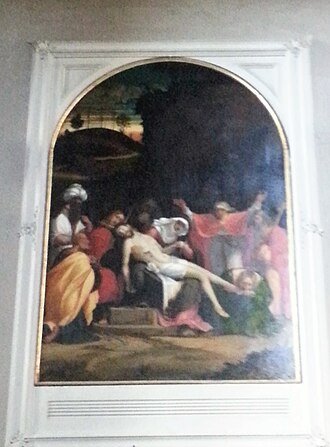
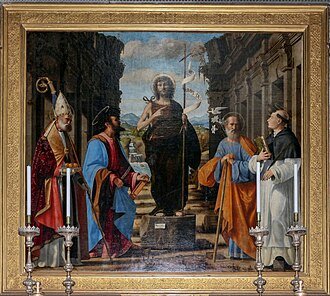

This religious painting, dated 1517, depicts the Throne of Mercy, showing God the Father and Jesus of Nazareth together with Saint Augustine of Hippo. The available record offers no further details about its commission, composition or technique, so any reading of the scene is limited to what its title and main figures suggest.

A work by Andrea Previtali dated 1520 and held at the Accademia Carrara. It depicts Saint Ursula, a devotional figure associated with Cologne, within Renaissance religious art. The record suggests a large altarpiece-scale oil painting, but reliable details about its commission or composition are not available here.

Portrait of a Man, painted by Andrea Previtali in 1502 using tempera. It shows an unidentified male sitter, and the focus falls on the presence of the figure and the careful treatment of the face. With no further documentation available, it is best described cautiously and placed within early sixteenth-century Italian portraiture.
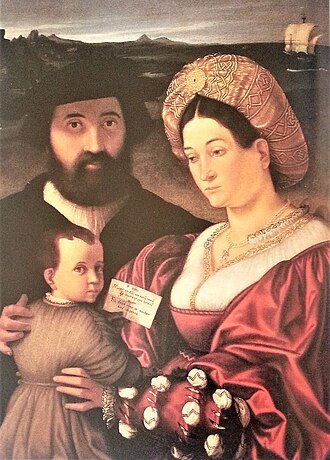
This painting by Andrea Previtali belongs to the family portrait genre, which gathers several members of a household within a single scene. Its title names Giovannino, linked to the Casotti family, but reliable details about its commission or composition are not known. The figures' poses and arrangement probably convey the bonds between them.

Polyptych painted by Andrea Previtali in 1525 for the church of Santo Spirito in Bergamo, where it remains today. The record offers no further information about its commission or technique, so the work can only be described in general terms: a set of painted panels designed for an altar, typical of religious painting in northern Italy during the Renaissance.

Painting by Andrea Previtali dated 1512 and executed on canvas. It shows the Virgin Mary nursing the infant Jesus, a subject known as the Virgin of Milk, and belongs to religious painting. It is held in the Accademia Carrara in Bergamo. The record offers no further details about its commission, composition or symbolism, so it is best to restrict any description to what the image shows.

This painting by Andrea Previtali, dated 1525, brings together the Virgin Mary with the Christ Child, Saint Jerome, a woman and another child. The Holy Family accompanied by Saint Jerome was a common subject in Italian Renaissance painting. No further details about its composition or commission are given, so the scene is best viewed with caution.


A work by Andrea Previtali, a painter active in northern Italy in the early sixteenth century, executed in oil and held in a museum in Bergamo. The available information does not allow us to determine with certainty its subject, date or original commission, so the museum's record is the best place to find further details.

A work attributed to the Venetian painter Andrea Previtali, executed in oil and held in the Civic Museums of Padua. With the limited information available, its subject, date and original commission cannot be stated with certainty, so it is best approached through its material features: an upright format and oil technique, common in early sixteenth-century painting in the Veneto.


Where to see the work
- Accademia Carrara Bergamo · 5
- National Gallery London · 2
- Gallerie dell'Accademia Venice · 2
- Pinacoteca di Brera Milan · 1
- Sant’Andrea Bergamo · 1
- Museo Poldi Pezzoli Milan · 1
- Church of Santo Spirito, Bergamo Bergamo · 1
- Bergamo Cathedral Bergamo · 1
- Collection Bemberg Toulouse · 1
- Civic Museums of Padua Padua · 1
Teachers and pupils
Studied with
- Giovanni Bellini 1430–1516
Pupils
- Palma Vecchio 1480–1528
Curiosities
Not Giorgione
In 1937 his work first drew attention in the United Kingdom for "not being Giorgione". Kenneth Clark, then Director of the National Gallery, bought two small rustic panels from a Vienna dealer for £14,000, a high price at the time, despite opposition from his curators. The attribution to Previtali was published in 1938 in The Burlington Magazine by G. M. Richter, based on research by Philip Pouncey.
A masterpiece above an altar
Sources regard his masterpiece as an Annunciation that stands over the high altar of the little-known church of Santa Maria del Meschio in Vittorio Veneto. It hangs in a church rather than a major museum, where the painting remains in the devotional space it was made for.