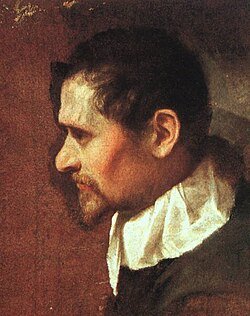
Annibale Carracci (Bologna, 1560 – Rome, 1609) was an Italian painter and printmaker and one of the key figures of the early Baroque. The most famous member of the Carracci family of painters, alongside his younger brother Agostino and his cousin Ludovico, he helped shape a current known as Roman-Bolognese classicism. He is often seen as Caravaggio's great artistic rival, since he represented an approach opposed to Caravaggio's. His significance lies in a synthesis of traditions that shaped the painting of the generations that followed.
Training in Bologna
Annibale was born in Bologna and was probably first trained within his family. His cousin Ludovico and the painter Bartolomeo Passarotti are also mentioned as possible teachers. In 1582 he, Agostino and Ludovico opened a studio that was first called the Academy of the Desiderosi, meaning those who desire fame and learning, and later the Incamminati, meaning the progressives, or those who open a new way. The school eventually came to be known as the Eclectics. Their aim was to renew a painting that they felt had decayed during Mannerism and that now seemed threatened by the naturalism of Caravaggio, whom some called the Antichrist of art.
Eclecticism between Florence and Venice
The Carracci placed special emphasis on the linear drawing of the Florentine tradition, as seen in Raphael and Andrea del Sarto, rather than the loose, apparently unplanned designs associated with Caravaggio. They were also drawn to the rich, subtly modulated colour of Venice, above all the work of Titian, which Annibale and Agostino studied during their journeys around Italy in 1580–81 at the urging of Ludovico. This blend of sources became the defining trait of the Bolognese school, whose most prominent followers included Domenichino and Guido Reni.
In many early works it is hard to tell one brother's hand from another. The frescoes on the story of Jason in Bologna's Palazzo Fava (c. 1583–84) bear the Carracci signature, which suggests all three took part. In 1585 Annibale completed a Baptism of Christ for the church of San Gregorio in Bologna, and in 1587 he painted an Assumption for San Rocco in Reggio Emilia. Around 1593 he finished, with Lucio Massari, a Virgin enthroned with Saints John and Catherine, and his Resurrection of Christ also dates from that year.
The Farnese ceiling
Around 1595 Cardinal Odoardo Farnese wanted the piano nobile of the gloomy Palazzo Farnese in Rome decorated, a building now home to the French embassy. Annibale had been recommended by the Duke of Parma, Ranuccio I Farnese. In November and December 1595 he travelled to Rome with Agostino to begin the Camerino with scenes from the life of Hercules, a fitting theme since the room housed the famous Farnese Hercules statue. Agostino soon withdrew because of disagreements.
Annibale produced hundreds of sketches and led a team that painted the ceiling of the grand salon with mythological scenes of the loves of the gods. The biographer Giovanni Bellori described the whole as Human Love Governed by Celestial Love. The decoration pairs a notably rich illusionism with a restrained classicism modelled on Michelangelo's Sistine ceiling and on Raphael's loggias in the Vatican. For the seventeenth and eighteenth centuries it was regarded as an unrivalled masterpiece of fresco of its time. His preparatory drawings were studied as models of composition for large history paintings.
Caravaggio and the quarrel over style
The seventeenth-century critic Giovanni Bellori, in his treatise Idea, presented Carracci as the paragon of Italian painters, a promoter of a rebirth of the great tradition of Raphael and Michelangelo. Bellori admired Caravaggio's talent but lamented his naturalism and, even more, his turbulent character. Still, patrons of the time such as the Marquis Vincenzo Giustiniani valued both men, and patrons and pupils did not split into irreconcilable camps.
The technical contrast was clear. Caravaggio almost never worked in fresco, which was regarded as the true test of a great painter, while Carracci excelled at it. Caravaggio's dark canvases suited contemplative altarpieces, but not well-lit walls and ceilings like those of the Farnese palace. Wittkower found in these frescoes a tremendous joy in living. Today, however, many visitors to the Cerasi Chapel in Santa Maria del Popolo focus on Caravaggio and overlook Carracci's Assumption, which is worth comparing with Caravaggio's own Death of the Virgin.
Landscape, genre and caricature
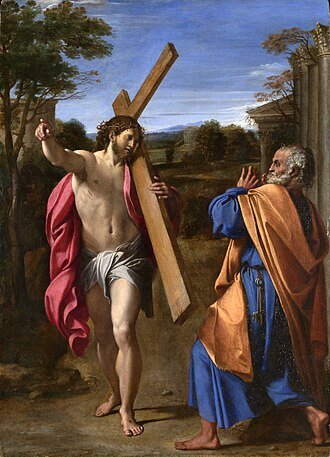
Carracci was remarkably eclectic. He painted history, landscapes, genre scenes and portraits, and left a series of self-portraits across his career. He was one of the first Italian painters to give landscape priority over figures, as in his Flight into Egypt, and in that genre he was followed by Domenichino, his favourite pupil, and Claude Lorrain. His less formal side appears in his caricatures and early genre pictures such as The Beaneater. His late works include Saint Roch Giving Alms of 1595 and Domine, quo vadis? (c. 1602), whose economy of composition and precision of gesture influenced Poussin.
Melancholy and final years
Around 1600 Annibale fell into a depression, perhaps because his laborious frescoes in the Palazzo Farnese were poorly paid and coolly appreciated. In April 1606 Cardinal Odoardo Farnese complained that a "heavy melancholic humour" kept Annibale from painting for him. That same year Annibale signed a print, the Madonna of the Bowl. In 1607 he could not finish a Nativity commissioned by the Duke of Modena, and in 1608 he agreed with a pupil that he would spend at least two hours a day in his studio. Little documentation explains why his brush fell silent, and speculation abounds. He later suffered paralysis in one arm and relied on assistants.
The murals of the Herrera Chapel in the church of Santiago de los Españoles in Rome are dated to these years, and were completed by his assistants. When the church was sold in the mid-nineteenth century, the frescoes were removed from the walls. They are now divided between the MNAC in Barcelona and the Prado in Madrid. Annibale died in Rome in 1609 and, as he wished, was buried near Raphael in the Pantheon.
Legacy
Artists as different as Bernini, Poussin and Rubens praised his work. Many of his assistants and pupils, at the Farnese palace or in the Herrera Chapel, became the leading artists of the following decades. They included Domenichino, Francesco Albani, Giovanni Lanfranco, Domenico Viola, Guido Reni and Sisto Badalocchio. In the following century, neoclassical critics such as Winckelmann, and later John Ruskin, criticised Baroque art in general. Carracci was partly spared that reproach, because he was seen as an emulator of Raphael and because his frescoes drew on the themes of ancient mythology.
Works (78)






This oil on canvas by Annibale Carracci, dated 1582, shows a young man in the act of drinking. Nothing more is known about its commission or context, so it should be approached cautiously. It is held by the Cleveland Museum of Art.

Painted by Annibale Carracci in 1593, this religious work brings together the Virgin Mary, the Christ Child and the Holy Family beside a column. A cherry stands out among its motifs. The available information does not clarify the commission or the circumstances of its creation, so it is best to focus on what the scene shows.

This work by Annibale Carracci, dated 1595 and painted in oil on canvas, is an example of religious painting in which the Virgin Mary is the central figure. The record notes a dove, a common symbol of the Holy Spirit, and a musical instrument, elements that accompany the scene of the coronation. No information about its commission or reception is available here, so it is best approached through its figures and iconography.

Oil on copper painting by Annibale Carracci, dated around 1600, showing Saint John the Baptist bearing witness with Jesus of Nazareth within a landscape. The record gives no details about the commission or provenance, so it is best to stay with what is visible: the composition relies on the natural setting and on the Baptist as the focus of the scene. The copper support, common in painting of the period, suggests a smooth surface and careful handling of the oil.

Painted in 1598 by Annibale Carracci, this work shows a putto, a child with a classical air, busy gathering grapes. Its mythological character suggests inspiration from antiquity, though the specific subject is not clearly defined. The landscape-format scene draws the eye to the infant figure and the bunch of fruit it holds.

Mythological painting by Annibale Carracci, dated 1595, showing Venus, Adonis and Cupid together in one scene. It is an oil on canvas. The available information does not describe its commission or reception, so the reading rests mainly on the presence of these three figures, whose amorous relationship forms the core of the subject.

Oil on canvas dated 1594 by Annibale Carracci, showing the crucifixion of Jesus of Nazareth within religious art. It is held at the Gemäldegalerie in Berlin. Being a small-format work, the available information does not specify who commissioned it or where it was originally intended to hang.

Genre portrait dated 1593, showing the lute player Giulio Mascheroni. Painted in oil on canvas, the picture focuses on the musician and his instrument, the lute. It is held at the Staatliche Kunstsammlungen in Dresden. No reliable information survives about who commissioned it or the circumstances of its making.
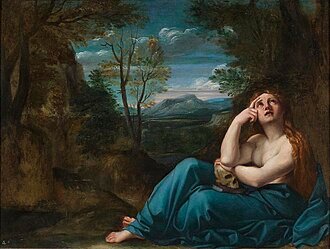
Oil on copper of small format, dated 1599 and attributed to Annibale Carracci. The work belongs to religious art and shows Mary Magdalene in a landscape, a subject in which the natural setting carries weight alongside the figure. The available information does not clarify its commission or original context.


This painting shows a river landscape in which a castle and a bridge stand out, and its title places the scene in a Roman setting. Executed in oil on canvas in 1600, it is now held in the Gemäldegalerie in Berlin. No information about its commission or original purpose is available, so any more detailed reading should be approached with caution.


The painting depicts a mythological episode: Diana, goddess of the hunt, is caught by the hunter Actaeon. It is oil on canvas. It is attributed to Annibale Carracci, but the date 1550 predates the painter's birth, so the date is probably wrong and should be treated with caution.

This oil on canvas brings together Venus and Cupid, a pairing very common in classical mythology and in art. It is attributed to Annibale Carracci, although the date of 1550 is doubtful, since the painter was born in 1560, so it should be treated with caution. The work is held at the Galleria Estense.


Annibale Carracci painted this oil on canvas in 1594, showing Saint John the Baptist within a landscape. It belongs to the Bolognese school and to religious art, and the saint's figure is set into a natural setting that plays a significant role in the composition. The work is held at the National Pinacoteca of Bologna.

The painting depicts the Assumption of the Virgin, the moment Mary is lifted up into heaven, a common subject in religious art. Executed in oil on canvas, its tall, narrow vertical format suggests it was probably intended for an altar, though no records confirm this. It belongs to the Bolognese school, associated with Annibale Carracci's circle.

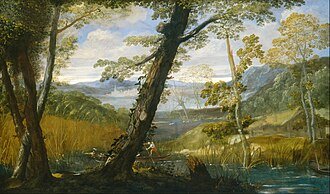
River Landscape with Hunter is a work by Annibale Carracci dated 1600 and held at the National Picture Gallery in Bologna. The available record offers no information about its commission, original patron or intended use, so any reading of its purpose should be treated cautiously. The title points to an outdoor scene in which a hunter is set within a riverside landscape of vegetation.

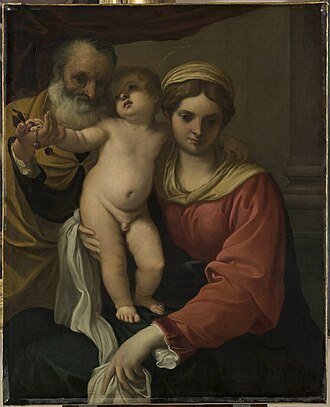
Oil on canvas by Annibale Carracci, dated 1598 and held at the Galleria Borghese. It belongs to religious art and, judging by its subject, depicts the Holy Family. The available information does not allow us to say more about its commission or composition, so the painting is best approached through its image alone.

Annibale Carracci painted this canvas in 1594, showing Samson, the biblical figure from the Old Testament, bound in chains. Beyond these basic facts, little can be stated with certainty about its commission or original setting, so the image is best read as a religious subject centred on the hero in captivity. The painting is now held in the Borghese Gallery.

Annibale Carracci painted this oil in 1597 within the Bolognese school, on a familiar devotional subject: Saint Francis of Assisi kneeling before a crucifix. The scene is restrained and contemplative, focused on the saint and his gaze directed toward the cross. Without further references, it is best to limit the description to this quiet devotional character.
Where to see the work
- Louvre Museum Paris · 8
- Pinacoteca Nazionale di Bologna Bologna · 8
- Museo di Capodimonte Naples · 5
- National Gallery London · 4
- Metropolitan Museum of Art New York City · 4
- Uffizi Gallery Florence · 3
- Hermitage Museum Saint Petersburg · 3
- Staatliche Kunstsammlungen Dresden Dresden · 3
- Galleria Borghese Rome · 3
- Museo del Prado Madrid · 2
- Royal Collection · 2
- Kunsthistorisches Museum Vienna · 2
- Galleria nazionale di Parma Parma · 2
- Palazzo Farnese Rome · 2
- Gemäldegalerie Berlin Berlin · 2
- Palazzo Colonna Rome · 1
- Staatsgalerie Stuttgart Stuttgart · 1
- Galleria Doria Pamphilj Rome · 1
- Santa Maria del Popolo Rome · 1
- Condé Museum Chantilly · 1
Teachers and pupils
Studied with
- Prospero Fontana 1512–1597
Pupils
- Antonio Marziale Carracci 1583–1618
Curiosities
Inventor of caricature?
According to early modern writing on art, Annibale Carracci was the inventor of caricature, understood as the ritrattino caricato, a portrait that exaggerates the disproportionate features of a person. The same discussion admits, however, that artists had been playing with their models' features well before the Carracci, doodling in the margins of their work.
Beside Raphael
As he wished, Annibale was buried in the Pantheon in Rome, near Raphael. The choice was symbolic, since the master whose classicism the Carracci hoped to revive lay there. It is also a measure of his standing that artists as different as Bernini, Poussin and Rubens praised his work.
A restored Venus
The Prado holds the famous painting Venus, Adonis and Cupid, which was restored in 2005. It is now considered superior to the version kept in Vienna, which makes the Madrid canvas an important reference for studying Carracci's work. It is one of the reasons his presence in Spain is so significant.