Antonio de Puga (Orense, 1602 - Madrid, 1648) was a Spanish Baroque painter, regarded as the first truly notable artist from Galicia. The son of a tailor of the same name, his career has been reconstructed largely thanks to the research of María Luisa Caturla. Documented information begins in 1635, when he dictated a first will in Madrid stating that he had worked for Eugenio Cajés on the decoration of the Salón de Reinos in the Buen Retiro palace. By then he was already a trained painter, with a portrait and a share in substantial palace commissions.
In Madrid he worked regularly for the nobility, producing equestrian portraits and, above all, landscapes that his contemporaries praised. His second will, dated 1648, shows a workshop with several assistants and a library of more than one hundred volumes.
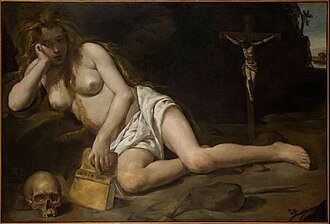
Only a very small body of work is securely by his hand: a signed Saint Jerome of 1636, now in the Bowes Museum. For this reason, works such as the Briganti Magdalen (1640) and the Oil Seller (1640) are attributed to him, and much of his output, including the genre scenes, remains a matter of debate.
Works (2)

The Olive Oil Vendor is dated 1640 and attributed to Antonio de Puga, painted in oil on canvas. It shows a street seller with his goods, in the everyday genre scenes common at the time. Held by the Museo Goya, the painting offers a glimpse of seventeenth-century street trades; beyond this, it is best described cautiously, since little is known about its original context.
Where to see the work
- Goya Museum Castres · 1