
Antonio Zanchi (born in Este, 1631; died in Venice, 1722) was an Italian Baroque painter who worked mainly in Venice. He matters for bringing intense realism and dramatic tenebrism to large-scale religious and allegorical canvases.
He trained in Venice with Matteo Ponzone and, above all, Francesco Ruschi, who steered him toward Tintoretto, his main model. Early on he etched frontispieces for opera librettos, including La Statira. By the 1660s he was influenced by Luca Giordano and Giovanni Battista Langetti, and in 1662 he was allowed to open his own academy. The Virgin Appears to the Plague Victims (1666) established his reputation. In the 1670s he worked in Munich, for the Residenz. During the 1680s his tenebrism softened, with blurrier contours and flatter colour. Late in life he concentrated on Este and its surroundings, continuing to paint religious works well into the eighteenth century. His pupils Antonio Molinari and Francesco Trevisani turned his Baroque realism into a lighter style suited to eighteenth-century taste.
Works (4)

As its title indicates, the painting shows the Virgin appearing to people suffering from the plague, a subject that in religious art was associated with protection against epidemics. Dated 1666 and painted by Antonio Zanchi, it is held at the Scuola Grande di San Rocco. The available information does not allow us to establish its commission or its precise context.
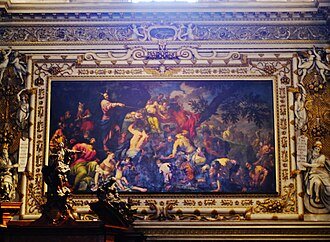
A work by the painter Antonio Zanchi, executed in oil and held at the basilica of Santa Maria Maggiore. The available record offers no further information about its subject, commission or date, so any more specific reading of the composition or its meaning would lack documentary support. It does place the painting within the output of an artist active in Venice during the seventeenth century.
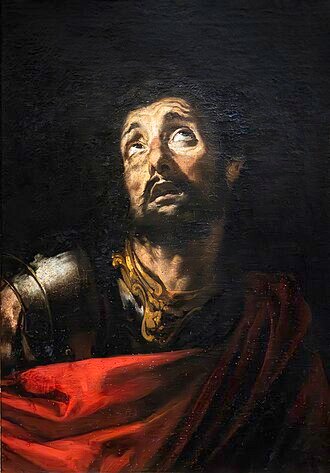
Antonio Zanchi painted this oil on canvas around 1650, showing the head of a warrior. No reliable information survives about who commissioned it or what the figure signified, so the picture is best read through what it shows: a male face with a concentrated expression, modelled through strong light and shadow typical of its period.

The painting depicts the biblical episode in which Noah, after the flood, drinks wine from his vineyard until he becomes drunk and lies exposed before his sons. Antonio Zanchi painted it in 1650 in oil on canvas. The commission and the specific circumstances of the work are not documented, so the scene is best approached through its biblical narrative.
Where to see the work
- Complesso di santa Caterina Treviso · 2
- Scuola Grande di San Rocco Venice · 1
- Santa Maria Maggiore Bergamo · 1
Teachers and pupils
Pupils
- Francesco Trevisani 1656–1746
- Antonio Molinari 1655–1704