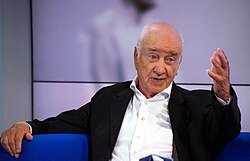
Armin Mueller-Stahl (born in Tilsit, East Prussia, in 1930) is a German actor whose career spans three film worlds: East German cinema, West German cinema and, later, American film. He matters because he worked on both sides of the Berlin Wall and reached international recognition relatively late in his working life, earning an Academy Award nomination for Best Supporting Actor for Shine.
As a teenager he was a noted concert violinist, but in the early 1950s he turned to acting in East Berlin. In East Germany he had success on stage and screen, appearing in films such as Her Third and Jacob the Liar, and starred in a spy series for East German television that was reportedly developed with the Stasi as a counterpart to the James Bond films. After protesting the stripping of citizenship from the singer Wolf Biermann in 1976, he was blacklisted by the government, and in 1980 he moved with his family to West Germany.
There he found steady film work. Notable titles include Rainer Werner Fassbinder's Lola and Veronika Voss, Andrzej Wajda's A Love in Germany, and István Szabó's Colonel Redl, as well as Agnieszka Holland's Angry Harvest. His move into American film came with Music Box, in which he played the father of Jessica Lange's character, followed by Avalon, Kafka and Night on Earth. For Utz he won the Silver Bear for Best Actor at the Berlin International Film Festival in 1992. His acting relies on restraint, which lets him make very different characters convincing: generals, intellectuals, gangsters and churchmen.
He made his directing debut with Conversation with the Beast in 1996. On television he played the German scientist Conrad Strughold in The X-Files and the Israeli prime minister in The West Wing, and in Germany he portrayed Thomas Mann in a miniseries about the Mann family. Later came Eastern Promises and Angels & Demons, where he played Cardinal Strauss, and in 2008 he appeared as Johann Buddenbrook in the film adaptation of Buddenbrooks. In 2011 he received an Honorary Golden Bear at the Berlin festival.
His legacy lies mainly in a long career that crossed political and linguistic borders while keeping a recognisably European sensibility. Many international audiences know him from Hollywood and American television, but his work in East Germany and in the auteur cinema of the 1980s remains the core of his reputation among film historians.