
August Macke
1887–1914 · German Expressionist painter, member of Der Blaue Reiter
August Macke (Meschede, 1887 - Souain-Perthes-lès-Hurlus, France, 1914) was one of the leading members of the German Expressionist group Der Blaue Reiter (The Blue Rider). He lived through a particularly active period in German art, when Expressionism was developing and the successive avant-garde movements forming elsewhere in Europe were arriving in Germany. His importance lies in the way he absorbed the aspects of these movements that interested him most, without fully submitting to any of them. He died at the front in the First World War at the age of twenty-seven, just as his work was beginning to mature. Like his friend Franz Marc, he belongs to the generation of young German artists whose careers were cut short by the war, and his painting, which moves between intense colour and the light of Tunisia, is now considered one of the most personal contributions to German Expressionism.
Childhood and early studies in Bonn
Macke was born in Meschede, in Westphalia, on 3 January 1887. He was the only son of August Friedrich Hermann Macke (1845-1904), a building contractor and amateur artist, and of Maria Florentine, who came from a farming family in the Sauerland region. Shortly after his birth the family settled in Cologne, where Macke attended the Kreuzgymnasium between 1897 and 1900 and became a friend of Hans Thuar, who also became an artist. In 1900, when he was thirteen, the family moved to Bonn, the city where he would spend most of his creative life. There he became friends with Walter Gerhardt and his sister Elisabeth, whom he would marry in 1909. The first images that impressed him were his father's drawings, the Japanese prints collected by Thuar's father and the works of Arnold Böcklin he saw in Basel in 1900.
Academy and first journeys
In 1904 his father died, and that same year Macke enrolled at the Kunstakademie Düsseldorf, where he studied under Adolf Maennchen until 1906. He also attended evening classes under Fritz Helmuth Ehmcke and worked as a stage and costume designer at the Schauspielhaus Düsseldorf. He visited northern Italy in 1905 and the Netherlands, Belgium and Britain in 1906. In 1907 he travelled to Paris for the first time, where he saw the work of the Impressionists, and shortly afterwards spent a few months in Lovis Corinth's studio in Berlin. His style took shape within French Impressionism and Post-Impressionism, and later passed through a Fauve phase, visible in works such as Portrait with Apples (1909) or Three Nudes on a Blue Background (1910).
The Blue Rider years
In 1910, through his friendship with Franz Marc, whom he had met in Munich, he came into contact with Kandinsky. For a time he shared the non-objective aesthetic and the mystical and symbolic interests of Der Blaue Reiter, although his painting never entirely lost its attachment to recognisable scenes. Subjects such as the Indians on horseback, painted in 1911 and now held by the Lenbachhaus in Munich, show this mixture of imagination and observation. The Storm also dates from 1911, and his vegetable fields and garden scenes of those years reveal an increasingly bold colour, in which forms are simplified without becoming abstract.
Delaunay, shop windows and Tunisia
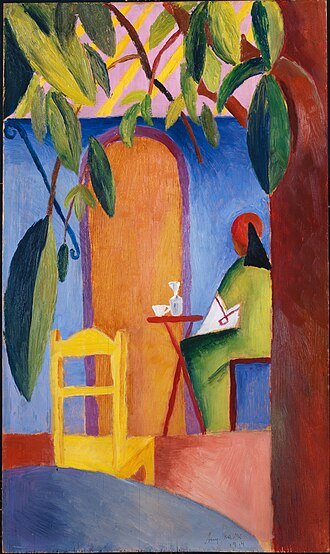
In 1912, in Paris, Macke met the work of Robert Delaunay, an encounter he later described as a revelation. Delaunay's chromatic Cubism, which Guillaume Apollinaire had called Orphism, shaped his art from that point onwards. His shop window pictures, such as Large Bright Showcase (1912) or Women in Front of a Milliner's Shop (1913), can be read as a personal interpretation of Delaunay's Windows, combined with the simultaneity of images he had seen in Italian Futurism. In April 1914 he travelled to Tunisia with Paul Klee and Louis Moilliet. The atmosphere of the country and the intensity of its light were decisive for the final phase of his work, which shows a brighter treatment of colour. This period produced watercolours such as the Kairouan series and paintings such as Turkish Café, now regarded as masterpieces.
Final months and legacy
Macke's career was abruptly ended by his death in September 1914, only weeks into the war, at the front in Champagne. He was buried in the German military cemetery at Souain-Perthes-lès-Hurlus. His last painting, Farewell, reflects the gloom that settled after the outbreak of the conflict. He left a short but intense body of work, which is held in museums in Germany and elsewhere, including the Museum Ludwig in Cologne, the Pinakothek der Moderne in Munich and the Thyssen-Bornemisza Museum. In 1959 the August Macke Prize was established, awarded by the districts of Arnsberg, Brilon, Olpe and Meschede, his birthplace. In 1991 the August-Macke-Haus museum was founded in Bonn, in the house where he lived from 1911 to 1914. His legacy lies chiefly in showing that German Expressionism could engage with French colour without losing its own character.
Works (60)


Painted in 1914 by August Macke, this oil on canvas is held at the Museum Ludwig. The title, Farewell, points to a moment of parting, and the date tempts viewers to link it to the outbreak of the First World War. Known details do not confirm a direct connection, so the title remains the main guide.

August Macke painted this work in 1911, and it is now held at the Saarland Museum. Its classification as abstract art points to a focus on form and rhythm rather than an identifiable scene. Beyond that, the available information is limited, so details about its subject, commission and reception remain uncertain, and the painting is best approached on its own visual terms.

August Macke painted this work in 1914. It shows a young woman seated before a fishbowl, where water and glass appear as overlapping planes of colour. The catalogue places it between Expressionism and Orphism, two currents that in those years sought pure colour as an expressive means. Without further reliable information, it is best to focus on how the composition turns a domestic subject into a play of transparency and bright tones.

August Macke painted this oil on canvas in 1913, titled The Fashion Store. The title suggests a scene set around the sale of clothing, but the available information says little about its composition, its commission or the setting in which it was made. Visitors can best approach it by looking closely at its colours and shapes, which carry most of its meaning.

This work by August Macke, dated 1914, depicts the Cathedral of St. Nicholas in Freiburg, Switzerland. With no further references available, it is best to stay with what is visible: the Gothic façade and tower are reduced to volumes and areas of intense colour, and the architecture almost dissolves into geometric forms. It illustrates how the German painter approached urban scenes in those years, focusing on light and colour rather than on detail.

Oil on canvas dated 1910 by August Macke. It shows a woman holding a bowl of flowers, a simple subject in which the figure and colour take centre stage. Beyond what is visible on the canvas, little can be said with certainty about its commission, its reception or the precise meaning of the scene.

Still life painted in 1912 by August Macke, an artist associated with Expressionism. The title refers to the toys of a boy named Walter, so everyday childhood objects take centre stage in the composition. Executed in oil on canvas, the work is held at the Städel Museum.

Painted in 1912 by August Macke, this oil on canvas is held by the Bern Museum of Fine Arts. Its title suggests an open-air scene of leisure, with tables and a garden setting. With no further documentation available, it is best not to specify details of its composition or commission.

Landscape painting by August Macke, dated 1911 and executed in oil on canvas. Its title points to fields of vegetables, an everyday rural subject treated as a painterly theme. It is held at the Kunstmuseum Bonn. Describing its composition and colour with confidence would require a more detailed study.

August Macke's small work, dated 1914, shows a garden seen through a fence and a gate, with houses in the background and an open sky. Made in pencil and watercolour on laid paper, its modest size suggests a direct study from the subject. Macke, linked to the Blue Rider group, was drawn to luminous colour and the simplicity of everyday forms.

Painted in 1914 by August Macke, this work shows a woman in a park, an everyday subject handled through colour and simplified form. Reliable information about the sitter, any commission, or the circumstances of its making is not available, so it is best to focus on what can be seen: the figure, the green setting, and the palette of this oil on canvas.

This 1913 painting by August Macke shows three young women wearing yellow straw hats. Executed in oil on canvas, it is held at the Kunstmuseum in The Hague. No further documentation on its commission or reception is available, so the most careful approach is to focus on what the image itself offers: the repeated yellow hat, a shared motif that links the three figures.

Four Girls is an oil on canvas dated 1914 and attributed to August Macke. Its title points to a scene with four young women, but little else is known about their arrangement, poses or the circumstances of its making. Today it is held by the Museum Palace of Art in Düsseldorf, where visitors can see it in person.

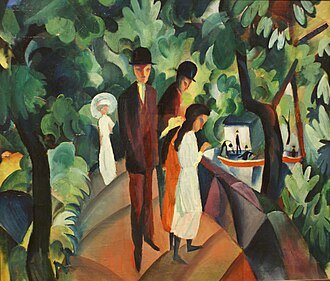
Painted in 1912 by August Macke and held by the Hesse State Museum, this work carries the title Walk on the Bridge. Its title suggests a scene of figures crossing a bridge, but without further documentation it is not possible to say with confidence who commissioned it, what its composition emphasizes, or how it was received at the time.


Painted by August Macke in 1912, this work is titled Russian Ballet I, which points to ballet as its subject. It is an oil painting on cardboard and is held by the Bremen art gallery. Beyond the title and these technical details, the record offers no information about its commission or the artist's intentions, so any reading of the scene should rest on what can be seen in the picture itself.

Painted by August Macke in 1911, this oil on canvas takes as its subject a street in Grau, as its title indicates. With no further reference material available, the context of its commission and the painter's intentions cannot be established, so the scene is best read through what the image itself shows.

Oil on canvas from 1910 by August Macke, showing a naked young woman covered by a veil. The nude genre focuses attention on the female figure and the cloth framing her head, while the contrast between skin and fabric carries much of the painting's visual interest.

A woman stands inside a millinery shop, where hats crowd the shelves and display stands. Macke, German painter, uses flat areas of bright colour and simplified outlines, turning an ordinary errand into a quiet study of shape and light. The work, dated 1913, is held at the Lenbachhaus.

Portrait of Elisabeth Erdmann-Macke, the artist's wife, painted in 1909 in oil on canvas. The sitter appears half-length beneath a hat that frames her face, and the composition relies on patches of colour and simplified forms. The work belongs to the Westphalian State Museum of Art and Cultural History and offers a useful view of Macke's early period, close to the experiments of German Expressionism.

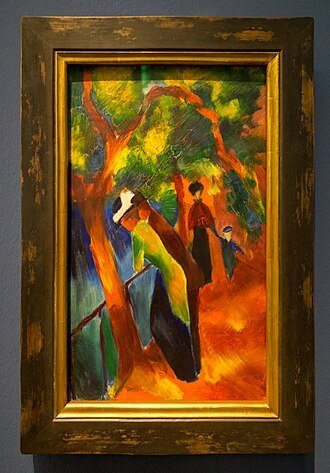

Oil painting by August Macke, dated 1913 and classified as a landscape. Its title, Stroller, suggests a figure taking a walk, and the subtitle refers to a large, bright promenade, pointing to an open-air scene with lively light. The work is held by the Westphalian State Museum of Art and Cultural History. The available information does not allow us to say more about its composition or setting.


Portrait of Ottilie Macke, painted in oil in 1907, shows the sitter wearing a white blouse. Given the upright format of the canvas, attention settles on the face and on the pale tones of the garment. The work is now held by the Westphalian State Museum of Art and Cultural History.

This painting by August Macke, dated 1912, depicts a garden seen from a path leading between trees and flowers. The record offers no further details about its commission or reception, so it is best appreciated for its composition: a bright space in lively colours and loose brushwork, reflecting the artist's interest in colour and everyday outdoor life.

A pencil and watercolour sketch dated 1907, made on the reverse of page 22 of a sketchbook. It shows a round dance beside a fountain. As a study, its light pencil lines and quickly applied colour suggest a scene captured on the spot rather than a finished painting, though little more is known about its purpose.

A portrait of Elisabeth Erdmann-Macke, painted by August Macke in 1909 in oil on a small panel-sized canvas of about 22 by 16 centimetres. The sitter is seated at a desk in a quiet, domestic setting. Its modest scale and everyday theme give the picture an intimate feel, closer to a personal study than to a formal commission.
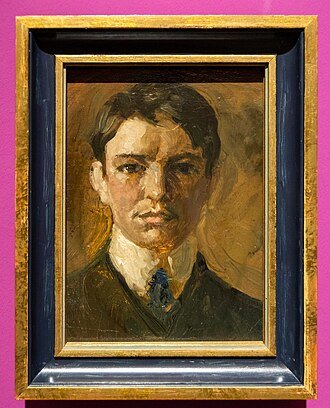
Self-portrait by August Macke, dated 1907 and painted in oil on a small support. The record offers no details about its commission or composition, so our reading is limited to its character as a portrait of the artist himself, a genre in which the painter observes his own image. Its small format invites an intimate, close viewing.

This portrait of Franz Marc was painted by August Macke in 1910 and presents the sitter as the work's central subject. It is held at the Neue Nationalgalerie in Berlin. The available information does not clarify the commission, the technique used or the artist's intentions, so any detailed reading should be approached with caution.


Painted in 1910 by August Macke, this oil on canvas shows a nude female figure wearing a coral necklace, which gives the work its title. The sitter is identified as Elisabeth Erdmann-Macke. The painting concentrates attention on the body and its single ornament, treated in a direct, uncomplicated manner. It is held in the Sprengel Museum collection.

A portrait study painted in 1907 by August Macke on cardboard, depicting Elisabeth Erdmann-Macke. The title indicates it was worked from memory, without a model in front of the artist, which suggests an exercise in capturing features and expression rather than a formal commission. The available information does not allow further details about its history or destination.

Self-portrait painted by August Macke in 1909 in oil on panel. The artist depicts himself wearing a hat, in a small format that probably points to a personal study rather than a commission. The work is held by the Kunstmuseum Bonn, and its modest size suggests an intimate character focused on observing his own figure.

This 1913 painting by August Macke shows a garden beside Lake Thun in Switzerland, as its title indicates. It is an oil on canvas now held at the Kunstmuseum Bonn. With the information available, reading the work rests mainly on its title and date, rather than on documented commissions or responses.

August Macke painted this tightrope walker in 1914, a figure poised on a rope in precarious balance. The theme of risk and stability runs through the scene, though little is firmly known about its commission or the painter's specific intentions. The work is today held at the Kunstmuseum Bonn.

Oil on canvas painted in 1911 by August Macke. Its title, St. Mary's with Houses and Chimney, points to a church view framed by dwellings and a chimney, with Bonn named as the location of the scene. The work is held by the Kunstmuseum Bonn. Without further documentation, its commission, intended audience and symbolism cannot be established with confidence.

This small painting from 1914, held at the Kunstmuseum Bonn, is titled Turkish Café. Its modest size suggests a work meant for close viewing rather than a monumental display. The title points to a café setting with Turkish associations, though the available information does not allow us to say more about the scene, its figures, or the circumstances in which it was made.

Landscape painted by August Macke in 1910, executed in oil on canvas. The work takes Lake Tegernsee in Bavaria as its subject and reflects the German artist's interest in nature and in a palette of bright colours. The available record offers no further details about its commission or reception, so it is best to confine remarks to what the picture itself shows.

This nude by August Macke, dated 1913, was painted in oil on cardboard. The record offers no further details about its commission or background, so we can only describe its subject: a female figure shown unclothed, treated by the painter within the German Expressionist circle in which Macke was a notable figure.


Painted in 1914 by August Macke, this genre scene takes a stroll as its subject, although the available information does not allow the figures or circumstances to be identified. The work is an oil on canvas held at the Staatsgalerie Stuttgart. Without further reliable sources, it is best described without assigning a meaning that is not documented.

Couple in the Forest is a painting by August Macke dated 1912, a period when the German artist was moving toward flat colour and simplified forms associated with Expressionism. The available information does not allow us to establish its commission or history with certainty, so it is best to focus on what the image itself shows.

A couple seated at a table in a garden, a domestic scene Macke painted in 1914. The documentation available does not establish who the sitters were or the exact circumstances of the work, so it is best read through what it shows: two figures gathered outdoors, with the table anchoring the composition. The picture is an oil painting on canvas from the last stage of his output.
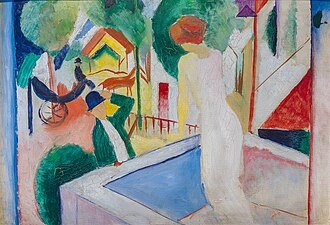
Painted in oil on cardboard by August Macke in 1914, this work is now held at the Suermondt-Ludwig-Museum. Titled Greeting, the work's circumstances are not documented in the available information, so its context and the painter's intentions can only be approached tentatively. Any reading of the scene should therefore be treated as a hypothesis.
Where to see the work
- Westphalian State Museum of Art and Cultural History Münster · 14
- Lenbachhaus Munich · 8
- Kunstmuseum Bonn Bonn · 6
- Museum Ludwig Cologne · 2
- Sprengel Museum Hanover · 2
- Städel Museum Frankfurt · 2
- Neue Nationalgalerie Berlin · 2
- Museum Folkwang Essen · 1
- Alte Nationalgalerie Berlin · 1
- Staatliche Kunsthalle Karlsruhe Karlsruhe · 1
- Kunsthaus Zürich District 1 · 1
- Kunsthalle Mannheim Mannheim · 1
- Saarland Museum Saarbrücken · 1
- Von der Heydt Museum Wuppertal · 1
- Kunstsammlung Nordrhein-Westfalen Düsseldorf · 1
- Kunstmuseum Bern Bern · 1
- Museum of Modern Art New York City · 1
- Kunstmuseum Den Haag The Hague · 1
- Museum Kunstpalast Düsseldorf · 1
- Hamburger Kunsthalle Hamburg · 1
Curiosities
A record in Berlin
In 2007, the Berlin auction house Villa Grisebach sold Woman with a Parrot in a Landscape for 2.4 million euros, a record price for the artist. The sale confirmed that works from his last period had an international demand far greater than they had enjoyed for much of the twentieth century.
A history shaped by Nazism
The provenance of Woman with a Parrot in a Landscape records that the work was confiscated in 1937 as 'degenerate'. The 2008 catalogue of Macke's works also mentions Hildebrand Gurlitt, Hitler's art dealer, in the provenance, showing how Expressionism suffered official persecution under the Nazi regime.
A 2011 auction
In 2011, Christie's auctioned In the Bazar, from the collection of the dealer Ernst Beyeler, for 3.96 million pounds, four and a half times the high estimate. Earlier, in 2000, Market in Tunis, painted in 1914, had sold for 2.86 million pounds, showing how the value of his Tunisian work had risen.