
August von Pettenkofen
1822–1889 · Austrian genre and military painter with Hungarian subjects
August von Pettenkofen (Vienna, 1822 – Vienna, 1889) was an Austrian painter who bridged the Biedermeier genre tradition and the realism of the later nineteenth century. Born in Vienna to a merchant and landowner, he grew up on his father's estate in Galicia and, after his father's death, with the family of his cousin Ferdinand von Saar in Vienna.
In 1834 he gave up a military career to enrol at the Academy of Fine Arts in Vienna, where he studied under Leopold Kupelwieser and Franz Eybl. He first painted genre scenes in the Biedermeier manner. During the Revolutions of 1848 he turned to military painting in the manner of Carl Schindler, and a period in Szolnok, Hungary, pushed his style toward the picturesque. In 1852 he went to Paris and came under the influence of the Barbizon school.
He is admired for depicting the quiet, melancholy lives of Hungarian peasants and Gypsies with sincerity, avoiding theatrical pathos and forced humour. Works include The Birdcage, The Village Scribe and Emperor Franz Joseph at the Taborbrücke, dated 1862. He joined the Vienna Academy in 1866, became an honorary member of the Munich Academy in 1872 and was knighted in 1876. His legacy lies in later Austrian genre painting.
Works (1)
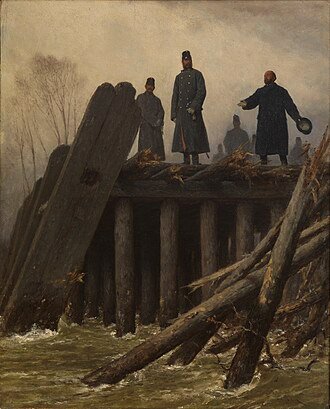
Pettenkofen depicts Emperor Franz Joseph I on the Taborbrücke in Vienna, capturing a moment of everyday city life. The small oil-on-panel work is dated 1862 and is held in the Vienna museum. With the information available, little more can be stated with confidence about its commission or reception.
Where to see the work
- Vienna Museum Vienna · 1