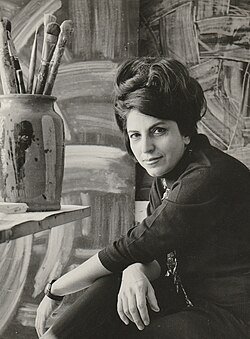
Behjat Sadr (born Arak, Iran, 29 May 1924; died at sea off Corsica, 10 August 2009) was an Iranian modernist painter whose works were shown in New York, Paris and Rome. She is known for applying paint with a palette knife onto canvas and metal surfaces, producing compositions built on visual rhythm, movement and geometric forms. She is regarded as the first Iranian woman painter of her generation to gain recognition equal to that of her male contemporaries.
After studying at the Faculty of Fine Arts of the University of Tehran, she won a scholarship to Italy, where she attended academies in Rome and Naples. Soon after arriving in Rome she moved away from academic painting toward an abstract approach. Her first major exhibition was at the La Bussola gallery in Rome in 1958, a year after she showed at the Venice Biennale of 1956. In 1957 she returned to the University of Tehran as a professor, despite opportunities to keep painting in Rome and Paris, and taught there for almost twenty years. In 1962 she received the Royal Grand Prize at the Tehran Biennale.
In Italy she encountered Art Informel and Abstract Expressionism, and developed all-over compositions of repeated, curving strokes. In the late 1960s she also explored optical and kinetic effects, including installations with painted Venetian blinds. In her 1974 Untitled, she poured industrial paint onto supports laid on the floor, then removed or reshaped it with broad knives.
She was diagnosed with breast cancer in the 1980s but kept painting. She died of a heart attack in 2009 while swimming in Corsica, in line with a wish to die at sea that she had expressed in several writings. A documentary, Behjat Sadr: Time Suspended, directed by Mitra Farahani, followed in 2006, and in 2020 an endowment fund was established to protect and promote her work.