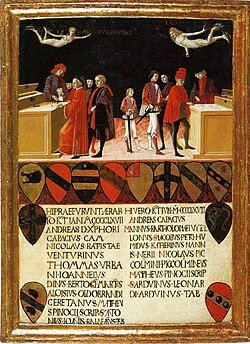
Benvenuto di Giovanni del Guasta (Siena, 1436 - Siena, 1518) was a painter of the Sienese school and one of the few masters who kept the late Gothic tradition alive at the close of the fifteenth century and the start of the sixteenth. He worked almost his entire life in Siena, where he is first documented in 1453 with contributions to the baptistery. He was probably trained by Vecchietta, though his work also shows the influence of Paduan and Florentine art.
From the 1480s his style changed: he adopted bright colours, sharper light and more vivid backgrounds, influenced by what Liberale da Verona and Girolamo da Cremona had painted in the cathedral. His masterpiece is a triptych dated 1475 in the Basilica of San Domenico in Siena. His son Girolamo, also a painter, worked in his workshop, which makes it difficult to tell some works apart.
Benvenuto's legacy rests on a large number of surviving works, many held in museums in Washington, London and Tulsa, and on the continuity of late Gothic Sienese painting in his workshop.
Works (3)
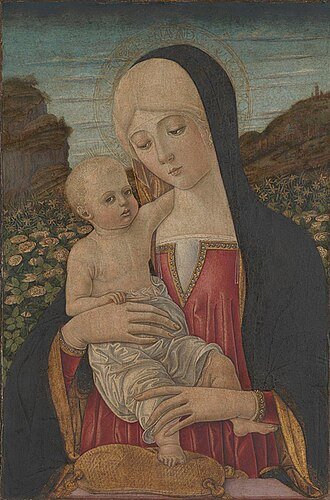
This panel shows the Virgin Mary with the Christ Child, a common subject in religious painting. Benvenuto di Giovanni painted it in 1474, and it is now held at the National Gallery in London. The available information does not clarify the original commission or setting, so the image itself deserves close attention.
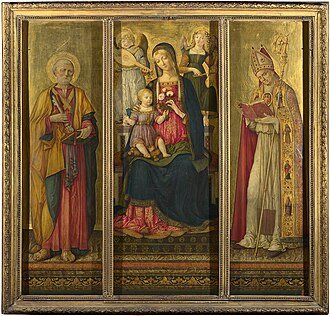
Religious painting by Benvenuto di Giovanni, dated 1479 and held at the National Gallery in London. The scene brings together the Virgin and Child with Saint Peter and Saint Nicholas of Bari, figures commonly found in altarpieces of the period. Without further documentation available, it is best to limit remarks to the arrangement of the saints around the Virgin.
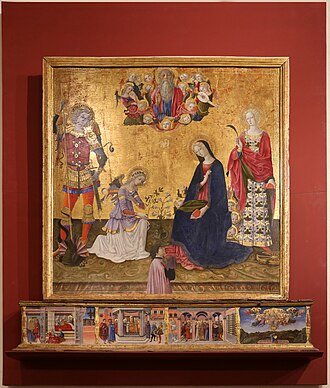
Painted in 1466 by Benvenuto di Giovanni, this religious work brings together the Virgin Mary, Saint Catherine of Alexandria and the Archangel Michael in one shared scene. Gathering holy figures of different rank within a single composition was a common devotional choice in the period, probably meant to invite viewers into a unified sacred space. The painting is held in the Diocesan Museum in Volterra.
Where to see the work
- National Gallery London · 2
- Diocesan Museum in Volterra Volterra · 1