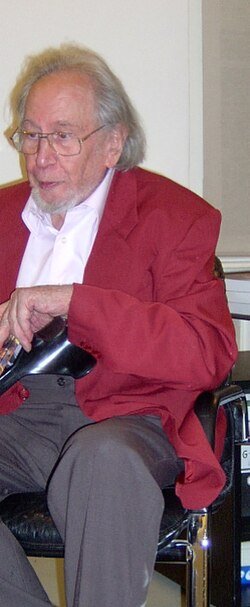
Bernhard Heisig
1925–2011 · German painter of the Leipzig School
Bernhard Heisig (Breslau, 1925 – Strodehne, 2011) was a German painter, a member of the Leipzig School alongside Hans Mayer-Foreyt, Werner Tübke and Wolfgang Mattheuer, and regarded as one of the most important representatives of art in East Germany. His work, with its abstract elements, goes beyond socialist realism, although some of his historical paintings and political portraits sit uneasily with that reading.
He was the son of the painter Walter Heisig, who gave him his first training. He served as a volunteer in a Waffen-SS division of the Hitler Youth during the Second World War, was seriously wounded and taken prisoner by the Soviets. His wartime experiences shaped much of his later painting. After his expulsion from Breslau in 1947 he settled in Zeitz and studied in Leipzig from 1948.
During the 1950s he worked mainly on drawings and lithographs about the Revolution of 1848 and the Paris Commune, and on book illustrations. He became a professor and later rector of the Leipzig University of Graphic Arts and Book Art, a post from which he was dismissed after criticising the cultural policy of the SED. In 1968 he left teaching and returned to independent work, painting large historical-political and social panoramas in the tradition of Max Beckmann and Oskar Kokoschka. His relationship with the authorities was ambiguous: he received official honours, returned his prizes in 1989 and left the SED that same year. From 1992 he lived and worked in Strodehne, in Brandenburg. He was known for repeatedly revising his paintings.
His legacy is felt above all through his students, among them Neo Rauch, who studied under Heisig and later worked as his assistant.
Teachers and pupils
Pupils
- Neo Rauch 1960–