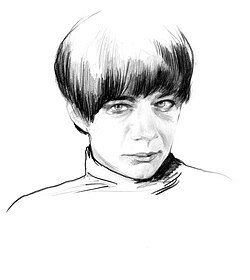
Bridget Louise Riley (born 24 April 1931) is an English painter best known for her Op Art works, which use geometric patterns to play with the viewer's perception of movement and colour. She became one of the most recognisable figures of the movement and has remained active for decades.
Riley was born in Norwood, London, and studied at Goldsmiths' College and the Royal College of Art. In the late 1950s she worked as an illustrator for an advertising agency and her early painting was figurative and semi-impressionist. Around 1958 and 1959 she adopted a pointillist technique, influenced by Georges Seurat, after meeting the painter and teacher Maurice de Sausmarez, who encouraged her to study Futurism, Divisionism and artists such as Klee. In 1960 she painted Pink Landscape in Italy, a pointillist study that marks the end of this phase.
After her relationship with de Sausmarez ended in 1960, Riley went through a personal and artistic crisis, and the paintings she made then, such as Kiss (1961), were in black and white. She developed from them a geometric style that produces sensations of movement and colour. Her first solo exhibition at Gallery One in 1962 brought her wider attention. From 1961 onwards many of her canvases were executed by assistants working from her preparatory drawings and instructions, a practice often read as a sign that the concept mattered more than the handwork. In 1967 she began to explore colour through stripe paintings, and after travels to Egypt in the 1980s she developed an 'Egyptian palette'.
Her legacy includes her influence on artists in other countries and large-scale commissions, among them the mural for the Chinati Foundation in Marfa, Texas, completed between 2017 and 2019. The composer Georg Friedrich Haas dedicated his Hommage à Bridget Riley to her, premiered in London in 2019.