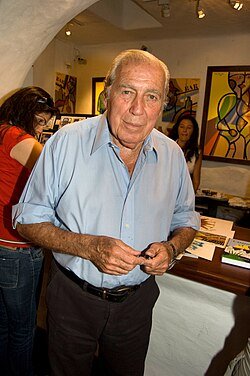
Carlos Páez Vilaró
1923–2014 · Uruguayan painter, ceramicist and builder of Casapueblo
Carlos Páez Vilaró (Montevideo, 1923 – Punta Ballena, 2014) was a Uruguayan painter who brought Afro-Uruguayan culture into the centre of his work. He also practised ceramics, sculpture, muralism and writing, and he was the intuitive builder of Casapueblo, his studio-home at Punta Ballena.
In 1941 he moved to Buenos Aires, where he worked in a match factory and then as an apprentice typesetter. Back in Montevideo around the age of twenty, he settled in the Mediomundo tenement and became close to the Afro-Uruguayan community and to the drum parades of the Sur and Palermo neighbourhoods. He wrote candombes for the lubola parades, painted banners and drums, and brought to his canvases the parades, dances, wakes and religious life of that world.
After a long journey through Brazil, Senegal, Liberia, the Congo, Haiti, Cameroon and Nigeria, he worked with Albert Schweitzer at the leprosy hospital in Lambaréné, Gabon, an experience he regarded as unforgettable. He later lived in New York, Buenos Aires and São Paulo, and met Picasso, Dalí, De Chirico and Calder in their studios. He joined the Grupo 8 and exhibited in 1960 at the Museo de Arte Moderno in Buenos Aires. Alongside Jorge Amado and Vinicius de Moraes he also wrote books such as La casa del negro and Candango.
His palette followed a personal code in which each colour carried a meaning: bluish grey stood for prestige, violet for aristocracy, ochre for poverty, red for stridency, blue for nostalgia and yellow for a cry. He avoided straight lines and right angles. He began building Casapueblo in 1958 and settled there permanently in 1997, working without plans or a plumb line; today the house is also a museum and hotel. Among his murals, a 162-metre work links the old and new headquarters of the Pan American Union in Washington.
The crash of Flight 571 in 1972 drew him deeply into events, since his son Carlitos was on board. He became one of the leaders of the search for survivors during seventy days, and that experience gave rise to the book Entre mi hijo y yo, la Luna. He died at Casapueblo in 2014, aged ninety. In 2005 he was named an «artist of both banks» by the Buenos Aires legislature, and in 2019 a samba school in Bella Unión dedicated its carnival parade to him.