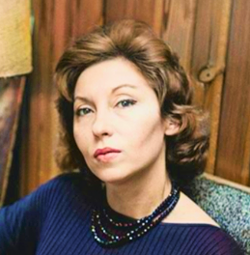
Clarice Lispector
1920–1977 · Ukrainian-born Brazilian novelist and short story writer
Chaya Pinjasivna Lispector, known as Clarice Lispector (Chechelnik, 10 December 1920 – Rio de Janeiro, 9 December 1977), was a Ukrainian-born Brazilian novelist, short story writer, children's author and poet, who also worked as a journalist, reporter and translator. She is considered one of the most important Brazilian writers of the twentieth century. She belonged to the third phase of Brazilian modernism, in the so-called Generation of 1945. Her work is difficult to classify. It explores intimacy and introspection through a wide range of narrative forms, and she herself described her writing as a kind of "non-style".
Born into a Jewish family in Podolia, in western Ukraine, she reached Brazil with her parents when she was barely a year old, fleeing the disasters that swept her homeland after the First World War. The family settled first in Maceió and then in Recife, where her mother died when Clarice was nine. At fourteen she moved with her father to Rio de Janeiro, where she studied law and began publishing journalism and short stories. At 23 she became famous with Near to the Wild Heart, written as an interior monologue in a style and language that were considered revolutionary in Brazil.
In 1944 she left Brazil after marrying the diplomat Maury Gurgel Valente, and for the next decade and a half she lived mostly in Europe and the United States. During those years the couple moved often, between Naples, Bern and Washington, and she kept up an intense correspondence with Brazilian friends. After returning to Rio in 1959 and separating from her husband, she published the story collection Family Ties and the novel The Passion According to G.H., now regarded as her masterpiece. In 1966 a fire started by a cigarette destroyed her bedroom and left her badly burned, with her right hand severely damaged. The injuries caused her frequent pain and depression for the rest of her life, yet she went on writing novels and stories, among them Água Viva. She died of ovarian cancer months after the publication of her last novel, The Hour of the Star.
Her reputation has grown considerably in recent decades. Benjamin Moser's biography Why This World, published in 2009, helped prompt an extensive retranslation of her work into English, and she became the first Brazilian writer to enter the prestigious Penguin Modern Classics series. Moser describes her as the most important Jewish writer in the world since Kafka. Several of her works have been adapted into films, and her name recurs often in Brazilian literature and music. Her library and manuscripts are held by the Fundação Casa de Rui Barbosa and the Instituto Moreira Salles in Rio de Janeiro.