
Constantin Hansen
1804–1880 · Danish Golden Age painter of historical scenes, portraits and altarpieces
Carl Christian Constantin Hansen, known as Constantin Hansen (3 November 1804 - 29 March 1880), was one of the painters associated with the Golden Age of Danish painting. Deeply interested in literature and mythology, and encouraged by art historian Niels Laurits Høyen, he tried to create a national historical painting based on Norse mythology. He is important because he paired that ambition with a wide output of altarpieces, portraits and history paintings.
He was born in Rome, the son of portrait painter Hans Hansen. The family soon moved to Vienna, where Constanze Mozart, widow of Wolfgang Amadeus Mozart, became his godmother, and within his first year they settled in Copenhagen, where he grew up. He entered the architecture school of the Royal Danish Academy of Fine Arts at twelve, but at twenty-one switched to painting and began training under Christoffer Wilhelm Eckersberg in 1828. Around then both parents died of typhus, leaving him the sole support of his younger sisters, and he took over commissions that had belonged to his father.
In 1835 he received a two-year travel stipend, followed by an extra year. He passed through Berlin, Dresden, Prague, Nuremberg and Munich on his way to Italy, where he spent long periods in Rome, Naples and Pompeii. There he met the sculptor Bertel Thorvaldsen and travelled with fellow Danish artists such as Jørgen Roed and Christen Købke. For the Copenhagen Art Union he painted A Group of Danish Artists in Rome (1837), and he also produced Italian folk scenes and studies of Roman antiquities and architecture in the spirit of Eckersberg.
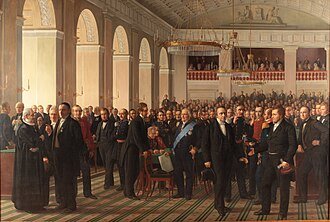
Back in Denmark he studied fresco in Munich and, together with Georg Hilker, decorated the vestibule of the University of Copenhagen from 1844 to 1853. Hansen painted the mythological figures while Hilker handled the decorations and frames. Later he worked on the monumental The Danish Constituent Assembly (1861-1865). He was named professor at the Academy in 1854 and became a member in 1864.
His legacy lives on in his altarpieces and portraits and in his family: his daughter Elise Konstantin-Hansen became a recognized painter, and Kristiane Konstantin-Hansen became a tapestry weaver. Among his pupils was Agnes Börjesson.
Works (5)



A portrait of a seated girl holding a basket heaped with fruit, a hat framing her face. Constantin Hansen painted it in 1827, while still young. The simple composition, focused on the figure and the colours of the fruit, reflects the painter's interest in genre portraiture and everyday life. The work is held by the National Gallery of Denmark.

Genre scene painted by Constantin Hansen in 1834, within the Danish Golden Age. It shows a naked boy, smiling, beside a dice game and a staircase, in a scene of everyday leisure. The composition is simple and intimate, with the figure's legs and trousers as main details. The work is held at the Louvre.
Where to see the work
- Statens Museum for Kunst Copenhagen Municipality · 3
- The Museum of National History at Frederiksborg Castle Hillerød Municipality · 1
- Louvre Museum Paris · 1
Teachers and pupils
Studied with
- Christoffer Wilhelm Eckersberg 1783–1853
- Christian August Lorentzen 1749–1828
- Gustav Friedrich Hetsch 1788–1864
- Johan Ludwig Lund 1777–1867
- Johan Frederik Clemens 1749–1831
Pupils
- Agnes Börjesson 1827–1900
Curiosities
An illustrious godmother
His christening had a distinguished godmother: Constanze Mozart, widow of Wolfgang Amadeus Mozart, who was connected to the family during their stay in Vienna. He was named after her, a detail that links a boy born in Rome to the musical world of the Austrian capital. It is a family anecdote that explains his full name and a brief but notable connection to one of the most famous composers of the period.
A sailor son
One of his sons, Hans Christian, worked as a sailor on a sailing ship and died at nineteen at sea. According to the sources, he fell overboard from the mast of the ship on which he served, a loss that marked the family. The couple had thirteen children, but four died within a year of being born, which shows how hard family life could be in the nineteenth century.