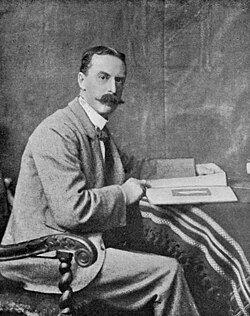
Edmund Blair Leighton
1852–1922 · English painter of historical and romantic genre scenes, associated with the Pre-Raphaelite movement
Origins and training
Edmund Blair Leighton was born in London in 1852, although the Spanish reference text gives 1853, so the exact date is disputed. He was the son of the portrait painter Charles Blair Leighton (1823–1855) and of Caroline Leighton, née Boosey. He was educated at University College School, and left at fifteen to work for a tea merchant. His wish to paint proved stronger, and he attended evening classes in South Kensington and then the Heatherley School of Fine Art in Newman Street, London.
First work as an illustrator
At the age of twenty-one he entered the Royal Academy Schools, the teaching body linked to the leading British art institution of his day. His first commissions were monochrome illustrations for Cassell's Magazine and for a book of British ballads. This work gave him practice in telling stories through figures and settings, but he soon gave up black-and-white illustration and spent the rest of his career working in oil on canvas.
Debut at the Royal Academy
His first painting exhibited at the Royal Academy was A Flaw in the Title, in 1874, which sold for £200. From then on he kept a steady presence at the institution, exhibiting there every year until 1920. He never became an Academician or an Associate, a detail worth noting when weighing his standing in London's art world, where membership brought prestige and visibility.
Style and subjects
Leighton was a fastidious craftsman, producing highly finished and decorative work. His historical paintings were romanticised scenes, often of chivalry and of women in medieval dress, with a broad popular appeal. His female figures had delicate features and an intense expression, and they were usually placed in landscapes, medieval interiors, or settings from the Victorian period or the Regency. Male figures often appear in the background. The result had an almost photographic realism, but its purpose was to evoke an idealised past.
Christopher Wood wrote that his work had a charm similar to that of James Tissot. Audiences admired his ability to recreate that earlier period, and his pictures were enjoyed as windows onto a world of love, honour and duty that already seemed distant.
Major works
Among his best-known titles are Faded Laurels (1889), Lady Godiva (1892), In Time of Peril (1897), The Accolade (1901), Tristan and Isolde or The End of the Song (1902), Alain Chartier (1903), The Hostage (1912) and Signing the Register (1920). Stitching the Standard, from 1911, is known in Spanish as Bordando el estandarte. Other paintings are held in public collections, such as Sorrow and Song at the Bristol City Museum, Waiting for the Coach and Adieu at Manchester Art Gallery, How Liza Loved the King at Towneley Hall in Burnley, and Un Gage d'Amour at Auckland Art Gallery Toi o Tamaki. Leeds City Art Gallery also holds examples of his work.
Private life
In 1885 he married Katherine Nash. The couple had a son, the painter Eric John Blair Leighton, and a daughter, Sophie Helen Blair Leighton. Edmund Blair Leighton died in London on 1 September 1922, in the city where he had been born.
Legacy
Leighton is associated with the Pre-Raphaelite movement and with the painting that followed it in the mid-to-late nineteenth and early twentieth centuries, although his work is less stylised and more naturalistic than that of the better-known Pre-Raphaelites. His legacy lies mainly in the image of medieval and Regency romance he left in British painting of his time, with a faithful public and public collections that still hold his works.
Works (13)

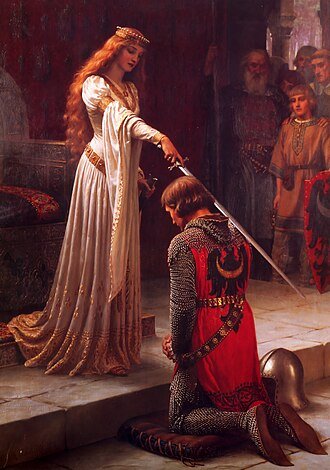
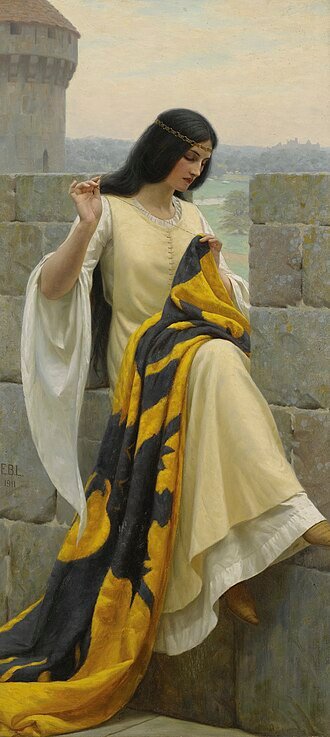

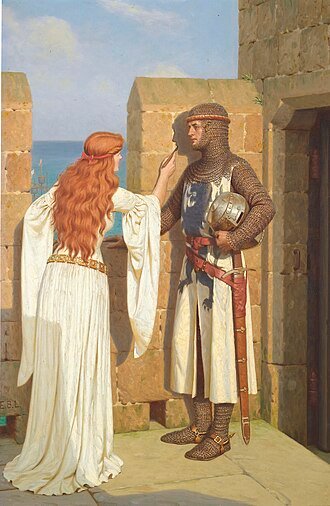
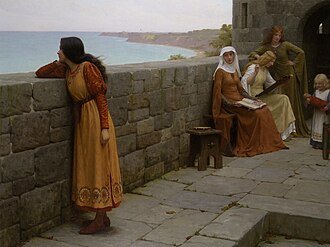


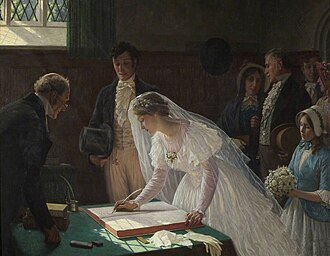

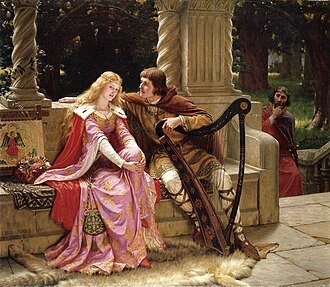

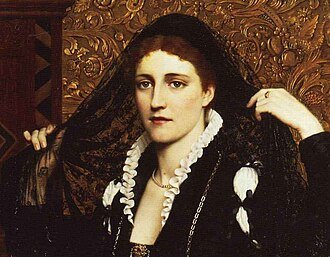
Olivia is an oil painting from 1887 by Edmund Blair Leighton, a British painter known for medieval court scenes with a sentimental tone. The record offers no further details about its specific subject or commission, so it is best described cautiously. Like much of the artist's work, it belongs to the narrative vein of Victorian painting, where historical costume and a female figure's gestures suggest a small story.
Where to see the work
- Auckland Art Gallery Auckland Region · 1
- Leeds Art Gallery Leeds · 1
- Bristol City Museum & Art Gallery City of Bristol · 1
Curiosities
From tea to painting
Leighton left school at fifteen to work for a tea merchant, a path far removed from painting. That early job did not stop his ambition. He continued studying at evening classes in South Kensington and in Newman Street until he entered the Royal Academy Schools at the age of twenty-one.
The monogram signature
Many of his paintings bear the initials E.B.L. rather than his full name. The detail can help viewers identify an unsigned-looking work at a glance. The sources consulted do not explain why he adopted this form of signature, so the reasons remain unknown.
A missing diary
Although he exhibited at the Royal Academy for more than forty years, Leighton appears to have left no diaries. Much of what we know about his life therefore comes from external records, from the works he exhibited, and from contemporary accounts, which leaves many gaps in the biography.