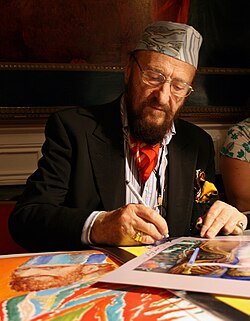
Ernst Fuchs
1930–2015 · Austrian painter and sculptor, co-founder of the Vienna School of Fantastic Realism
Ernst Fuchs (Vienna, 13 February 1930 – Vienna, 9 November 2015) was an Austrian painter and sculptor, and one of the founders of the Vienna School of Fantastic Realism, a movement set up in Vienna in 1946 by fellow students at the city's Academy of Fine Arts. His meticulous, symbol-laden work made him one of the most recognisable figures in postwar Austrian painting.
Born in Vienna into a Jewish family, he was an only child. He first trained at the St. Anna Painting School and then entered the Academy of Fine Arts Vienna, where he befriended Arik Brauer, Rudolf Hausner, Fritz Janschka, Wolfgang Hutter and Anton Lehmden. With them he helped found the Art-Club in 1946 and, later, the Hundsgruppe, set up in 1951 in opposition to it together with Friedensreich Hundertwasser and Arnulf Rainer.
Early on he was influenced by Gustav Klimt and Egon Schiele, and later by artists such as Edvard Munch and Pablo Picasso. Seeking the luminous effects of older German masters, he revived the mischtechnik, a mixed technique in which egg tempera builds up volume and oil glazes mixed with resin give a jewel-like finish. Between 1950 and 1961 he lived mostly in Paris, reading alchemical symbolism and the sermons of Meister Eckhart. Around 1957 he entered the Dormition Abbey on Mount Zion, where he painted religious subjects, including a cycle of three altarpieces on the Mysteries of the Holy Rosary for the Rosenkranzkirche in Hetzendorf, Vienna (1958-61).
After returning to Vienna in 1961 he set out his theory of the so-called verschollener Stil in Architectura Caelestis (1966). He also worked as a printmaker, sculptor and, from 1974, stage designer for operas by Mozart and Wagner. In 1972 he acquired the derelict Otto Wagner villa in Hütteldorf, restored it, and opened it as a museum in 1988. His legacy lives on chiefly in that museum and in the continuing tradition of Vienna's Fantastic Realism.