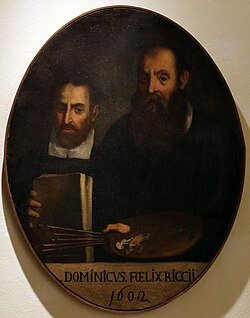
Felice Riccio, also known as Felice Brusasorci, was an Italian Mannerist painter born and mainly active in Verona. The son of the painter Domenico Riccio, he trained in his father's workshop, which he inherited when Domenico died. After a brief stay in Florence in 1557, he returned to Verona around 1570, and almost all of his surviving work is there.
His early paintings show a close link to Florentine Mannerism, with elongated figures in strained poses. Over time he worked more freely and elegantly, with soft, luminous touches, and in his maturity he moved closer to the style of Paolo Farinati. Among his key works are the Finding of Moses (1584), the Flagellation of Christ and the organ shutters of the Madonna di Campagna. His legacy lies in the Veronese workshop that trained Alessandro Turchi, Pasquale Ottino and Marcantonio Bassetti, who finished The Fall of the Manna after his death in 1605.
Works (9)
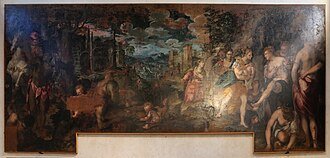
A work by Felice Brusasorci, an Italian painter of the seventeenth century, held in the G.B. Cavalcaselle Fresco Museum. It is a religious painting, a genre that filled much of his output. The available record does not specify the scene depicted, the exact date or the original commission, so a fuller reading would require consulting the museum's catalogue.

This painting by Felice Brusasorci, executed in oil on canvas, presents the Holy Family accompanied by a female saint, within religious art. The available information does not specify its commission or date, so any interpretation should be read with caution. It is now held at the Castelvecchio Museum.
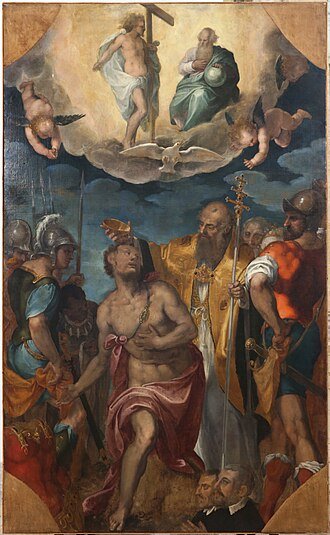
A religious painting by Felice Brusasorci showing the baptism of Emperor Constantine by Pope Saint Silvester, following the traditional Christian legend. The oil on canvas is held at the Castelvecchio Museum. The available information does not allow us to determine with certainty the date of execution or the original commission.

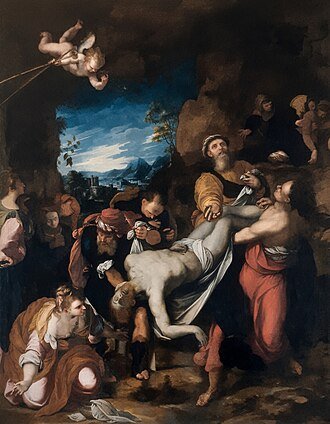
Large oil-on-canvas religious painting attributed to Felice Brusasorci and held at the Castelvecchio Museum. It depicts the moment when Christ's body is laid in the tomb, a common subject in sacred painting. The available information does not allow us to determine its date or original commission with certainty.
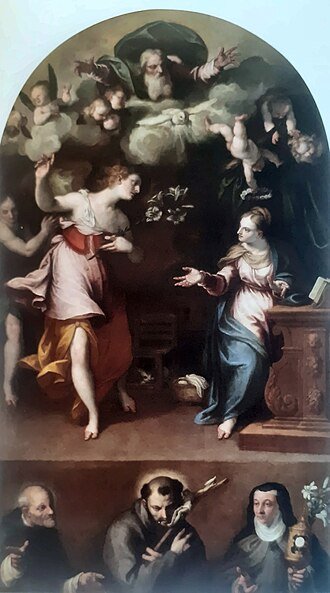
A work by Felice Brusasorci, a painter from Verona active in the late sixteenth and early seventeenth centuries, bringing together the Annunciation and three saints: Dominic, Francis of Assisi and Clare. Painted in oil on canvas in a tall, large format, it is held at the Castelvecchio Museum. The record places it within religious art; the details of its commission and history are not documented here.

This painting by Felice Brusasorci depicts Christ praying in the Garden of Gethsemane, the Gospel moment when he withdraws to pray before his arrest. It is executed in oil on canvas, in a tall vertical format that seems to emphasise the solitary figure. It is held at the Museo di Castelvecchio.
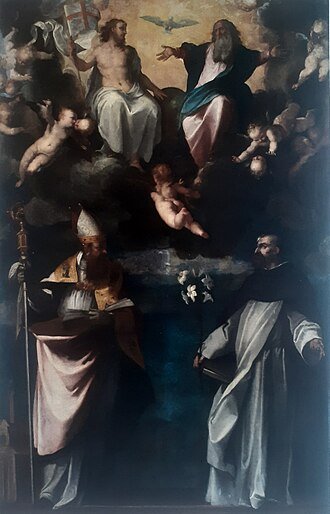

Large oil-on-canvas painting by Felice Brusasorci, dated 1595, held in the collection of the Museo di Castelvecchio in Verona. Its very elongated format, nearly nine metres wide, suggests it was made for a large, monumental setting, probably a wall or room decoration, though reliable details about its commission and subject are not known.
Where to see the work
- Castelvecchio Museum Verona · 8
Teachers and pupils
Pupils
- Alessandro Turchi 1578–1649
- Marco Antonio Bassetti 1586–1630
- Pasquale Ottino 1578–1630
Curiosities
A painter with several names
He is known as Felice Riccio, Il Brusasorci, Brusasorzi or Felice Brusasorci. This variety of names is worth keeping in mind when searching for his works in catalogues and museums, where they may appear under any of them. His birth date also varies between sources, which adds another difficulty to reconstructing his biography precisely.
Pupils lost to the plague
Several of his pupils died during the plague of 1630, among them Girolamo Vernigo, Bartolommeo Farfusola, Paolo Zuccaro and Zeno Donato. The list also includes Michelangelo Bozzoletta and Girolamo Maccacaro, which gives an idea of the size of his Veronese school and of the blow the epidemic dealt to the workshop.