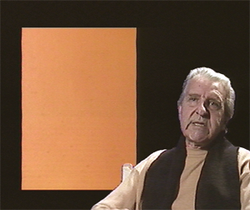
Fernand Leduc
1916–2014 · Canadian abstract expressionist painter
Fernand Leduc (Montreal, 1916 – Montreal, 2014) was a Canadian abstract painter and a major figure in the Quebec contemporary art scene of the 1940s and 1950s. His career, spanning some fifty years, moved between Canada and France and made him one of the most active names in Quebec's contemporary art.
Leduc studied at the École des Beaux-Arts de Montréal from 1938 and graduated in 1943. Soon afterwards he joined the Contemporary Arts Society and played a significant part in forming Les Automatistes, the circle around Paul-Émile Borduas. He co-signed the Refus Global manifesto, although he did not contribute to the illustrated book that accompanied it. In 1946 he moved to Paris with his wife Thérèse Renaud and gradually distanced himself from the group. There he befriended Jean Bazaine, whose abstracted landscapes left a mark on his work of the early 1950s. He returned from Paris in 1953.
In 1955 he turned to a hard-edge abstraction, and in 1956 he helped found the Association des artistes non-figuratifs de Montréal, serving as its first president. His works of this period became increasingly concerned with the interaction and contrast of colours. He went back to France in 1959 and stayed until 1970. During those years a travelling exhibition organised with the National Gallery of Canada presented sixteen paintings in biomorphic abstraction. His legacy lies in linking Quebec automatism with European abstraction and in the association he helped establish.
Teachers and pupils
Studied with
- Paul-Émile Borduas 1905–1960