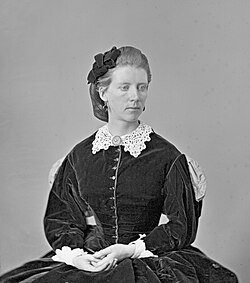
Frances Anne Hopkins
1838–1919 · British painter of travel and the fur trade in Canada
Frances Anne Hopkins (London, 1838 – England, 1919) was a British painter whose work records the lives of travellers in the fur trade of nineteenth-century Canada. Her importance lies in documenting, through sketches and paintings, a way of life that has since disappeared, including the final years of the fur trade and the work of the voyageurs.
Born into a family of artists and Arctic explorers, she was the daughter of the hydrographer Frederick William Beechey and probably received her artistic training at home. In 1858 she married Edward Martin Hopkins, secretary to the Hudson's Bay Company's Governor General, and they settled in Lachine, near Montreal. There she sketched the surroundings of her new home and later accompanied her husband on several inspection tours of trading posts, an unusual undertaking for a woman of her time.
Her best-known oil paintings, such as Canoes in a Fog, Lake Superior, were based on those sketches and were shown at the Royal Academy in London from 1869. After returning to England in 1870, she worked in her studio in Hampstead and continued to exhibit in London. Her work remained little known until recently, and it is now valued both as a historical record and as an example of a woman artist working under strong gender restrictions.
Works (1)

This urban scene shows a street in Montreal in 1866, with a cart, a house and a woman beneath an open sky. Painted by Frances Anne Hopkins, it focuses on the city's everyday life rather than on monuments or events. The available information does not clarify the commission or the precise meaning of the scene.