
Francesco Bassano the Younger (Bassano del Grappa, 1549 – Venice, 1592) was an Italian Renaissance painter and the eldest son of Jacopo Bassano, around whom a large family workshop was organised. His significance lies in helping create, together with his father and his brother Leandro, a horizontal format type of biblical and pastoral painting in which sacred subjects sit within broad landscapes with genre scenes.
He began by working with Jacopo, and his earliest known works can be dated to around 1568. His brushwork is livelier and looser than his father's, and a certain Mannerism appears in the handling of drapery. Around 1574 he started producing biblical subjects and cyclical series such as the seasons or the elements, set in high-horizon landscapes dominated by trees, a feature possibly inherited from Northern painters such as Lucas van Valckenborch. It is difficult to tell which pictures from the period before 1580 are by father or son, as their collaboration was very frequent. The Prado Museum holds many examples from this time, such as The Entry of the Animals into Noah's Ark or The Reproach of Adam.
Around 1580-1581 he is believed to have been in Florence, and from 1581 he settled in Venice, where he multiplied his commissions, including large crowded compositions for the Doge's Palace that show a certain creative exhaustion. In his last years his manner drew ever closer to that of Leandro. He suffered from hypochondria, which worsened his other ailments, and in the summer of 1592, soon after his father's death, he is believed to have taken his own life by throwing himself from a window. His brother Leandro carried on the family tradition.
Works (4)

This work by Francesco Bassano the Younger depicts The Last Supper, one of the most frequent subjects in religious art. It is an oil on canvas held in the Basilica of Santa Maria Maggiore. The available information does not allow us to establish with certainty when it was painted or the circumstances of its commission.

This square scene by Francesco Bassano the Younger brings together many figures absorbed in everyday tasks, surrounded by animals, food and tools that fill the foreground. Rather than telling a precise story, the painting conveys the hardship of rural labour with deliberate realism. Its animals and objects also carry moral meanings: the monkey beside the shirtless man warns against drink, and the broken egg hints at the fragility of life.
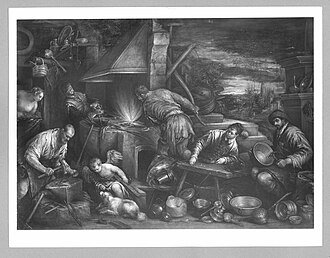
This work by Francesco Bassano the Younger, dated 1577 and painted in oil on canvas, depicts the forge of Vulcan, the god of fire and metals from classical mythology. The record offers no further details about its commission or history, so it is best to limit comments to what the painting itself shows.

This canvas by Francesco Bassano the Younger, dated around 1570 and held at the Museo del Prado, depicts the biblical moment when God rebukes Adam after the Fall. It is a large oil painting on canvas, with figures arranged across a broad space. Without further documentary sources, it is best to stick to describing the scene and its religious subject.
Where to see the work
- Santa Maria Maggiore Bergamo · 1
- Museo Soumaya Mexico City · 1
- Musées Nationaux Récupération · 1
- Museo del Prado Madrid · 1
Curiosities
A painting bought by Titian
Among the works of this period is The Entry of the Animals into Noah's Ark, a canvas that Titian acquired in Venice. That the great Venetian painter took an interest in a scene from this family workshop shows the prestige the Bassano had achieved. The picture belongs to the series of biblical compositions with animals and landscape that became so popular in the workshop, and it stands among the best-known examples of the period when father and son collaborated closely.
Commissions for the Doge's Palace
In Venice he received large official commissions for the halls of the Doge's Palace, the building where the Republic displayed its public image. These densely populated compositions pleased the authorities, although they are now seen as a sign of a certain creative fatigue. Their presence in such a representative building shows the position he had reached in the city during his final years of activity.