
Gabriel von Max
1840–1915 · Austrian painter of the Piloty School, born in Prague
Gabriel von Max (Prague, 1840 – Munich, 1915) was a Prague-born Austrian painter trained in the circle of Carl Theodor von Piloty, whose work moved history painting toward allegory and mysticism. Born Gabriel Cornelius Max, he was the son of the sculptor Josef Max. He studied in Prague, Vienna and Munich, and in 1867 earned his first critical success with "Martyr at the Cross", a painting that turned Piloty's dark palette into a psychologically charged religious symbolism. His importance lies in anticipating sensibilities later associated with Secessionist art.
His interest in spiritualism, somnambulism, Darwinism and mystical traditions shaped ethereal works such as "Light" and "The Last Token", the latter now in the Metropolitan Museum of Art in New York. From 1870 he kept a family of monkeys at his home on Lake Starnberg, painting them often and sometimes showing them as humans, and he relied on photographs to guide his compositions. Between 1879 and 1883 he was professor of history painting at the Munich Academy, a post he gave up to devote more time to his scientific collection. That collection of prehistoric, ethnological and anthropological finds is now the basis of the Reiss-Engelhorn Museum in Mannheim.
Around 1890 his reputation began to fade as newer movements such as Impressionism captured public attention, and painting became mainly a means of financing his costly anthropological acquisitions. In 1908 his painting "The Lion's Bride" became famous. He was ennobled in 1900 and died in Munich in 1915. He is remembered today for his allegorical painting and for the unusual link between art and science that marked his career.
Works (5)


Gabriel von Max painted this oil on canvas in 1878, taking as its subject Tannhäuser, the knight of the German legend later made famous by Wagner's opera. The scene brings together a man and a nude woman beside a sailing ship, under a moon that lights the composition. The record offers no further details about its commission or reception, so any reading of the painting should remain cautious.

A small oil-on-panel work by Gabriel von Max, dated 1880, showing a monkey beside a bunch of violets. The composition is intimate and modest in scale, and the contrast between the animal's thoughtful air and the delicacy of the flowers invites a close look. The record does not clarify the commission or the precise meaning the painter intended, so it is best to describe only what the picture shows.
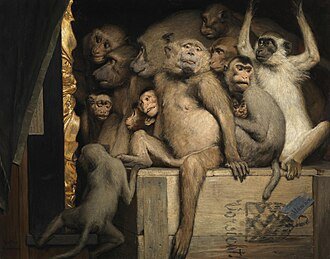
Painting by Gabriel von Max, dated 1889, in which several monkeys gather before a canvas as if they were art critics. The scene carries an ironic tone: the animals look at and assess the painting with serious, judgmental gestures, which invites reflection on the gap between artistic appreciation and mere imitation. It should be described cautiously, as the record offers little information about its context.

Painted by Gabriel von Max in 1892 in oil on canvas, The Seeress of Prevorst portrays Friederike Hauffe, whom the title identifies as a seeress. The available information does not describe the commission, the setting or the details of the composition, so any reading of the image must rest on the picture itself and on its title. The work is held by the National Gallery in Prague.
Where to see the work
- National Museum in Warsaw Warsaw · 2
- Bavarian State Painting Collections Munich · 1
- National Gallery Prague · 1
Curiosities
Paintings for chocolate
Max was among the contemporary artists whom a committee proposed to Cologne chocolate manufacturer Ludwig Stollwerck as candidates for commissioned designs. The project concerned the collectible picture cards that came with the company's products. It offered a way to bring the painting of the period into homes far removed from academy halls and galleries.
A painting with a scientific name
Max gave one of his 1894 works the title "Pithecanthropus europaeus (Alalus)", the name of a hominid species. The title clearly reflects his curiosity about anthropology and debates over human origins. It shows how his painting and his scientific interests fed each other throughout his career.