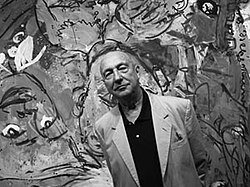
Georg Baselitz
1938–2026 · German and Austrian painter, also sculptor and printmaker, known for expressive figuration and inverted pictures
Georg Baselitz (born Hans-Georg Kern, Deutschbaselitz, Saxony, 23 January 1938 - Salzburg, 30 April 2026) was a German painter who became known in the 1960s for expressive, figurative work. He later acquired Austrian citizenship, in 2015. His importance lies above all in his decision, taken in 1969, to paint his subjects upside down, shifting attention from content to the surface and to the organisation of colour and form. This idea shaped much of his later work.
He grew up in post-war Germany, in the Soviet zone that would become East Germany. After two semesters at the Hochschule fur Bildende und Angewandte Kunst in East Berlin, he was expelled for what the authorities called sociopolitical immaturity. In 1957 he continued his studies in West Berlin, where he worked in the master class of Hann Trier. He read Ernst Wilhelm Nay, Kandinsky and Malevich, and as a child he had seen a painting by Louis-Ferdinand von Rayski hanging in his school's assembly hall. In 1961 he took the name Georg Baselitz, in tribute to his home town.
His first solo exhibition, at the Galerie Werner & Katz in Berlin in 1963, caused a scandal. Two paintings, including The Naked Man, were seized as obscene, and the legal case did not end until 1965. In 1965 and 1966 he produced the Heroes series, lone figures in barren landscapes, including The Great Friends. In 1969 he began inverting his motifs, and The Wood on Its Head was the first picture of this group.
During the 1970s he exhibited regularly in Munich and painted landscapes conceived as pictures within a picture. In 1972 he took part in documenta 5 in Kassel, where his work drew harsh criticism, and that same year he began to use a finger-painting technique. Toward the end of the decade he worked on diptychs, large linocuts and increasingly abstract paintings with script-like elements. He taught at the Karlsruhe academy from 1978 and at the Berlin university of the arts from 1983. In 1980 he showed a sculpture for the first time at the Venice Biennale, and sculpture became a significant part of his practice from the 1980s.
Baselitz received the Kaiserring of Goslar in 1986 and the Praemium Imperiale in 2004. In 1995 he had his first major retrospective in the United States, at the Guggenheim in New York, and in 2021 and 2022 the Centre Pompidou in Paris devoted a full survey to him. In the United States he was often read as a Neo-Expressionist, while in Europe he is more often considered a postmodernist. His legacy lies in treating painting as a constructed surface, and in a body of work that remained debated until the end of his life.