
Georg Friedrich Kersting
1785–1847 · German Romantic painter of Biedermeier-style interiors
Georg Friedrich Kersting (Güstrow, 1785 – Meissen, 1847) was a German Romantic painter, best known for interior scenes in which figures absorbed in everyday tasks are lit by candles or lamps. Trained at the Copenhagen Academy between 1805 and 1808, he settled in Dresden, where he became known as a portraitist of intimate domestic settings.
His work belongs to the first generation of German Romantic painters and shares the sentimental outlook of the literature of its time. He painted people and objects with great care, a precision that Biedermeier art would take up shortly afterwards. Works such as Man Reading by Lamplight (1814) and The Embroiderer (1817) balance exactness with soft shadow, conveying a quiet loneliness and an almost pantheistic sense of space that carries the landscape vision of his friend Caspar David Friedrich into the interior.
Between 1812 and 1813 he fought against the Napoleonic armies. He then taught in Dresden and Warsaw and, in 1818, took charge of the painting section of the Meissen porcelain factory, where he stayed until his death. His legacy lies in giving domestic life a serious pictorial dignity.
Works (10)
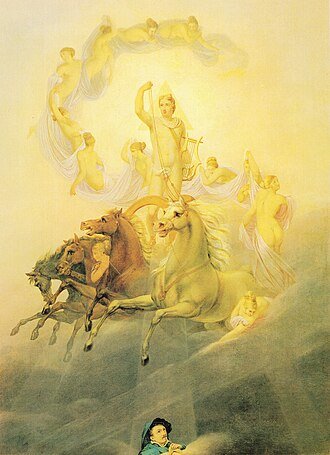
Painted in 1822, this mythological work shows Apollo, the god linked to the Sun, with his nimbus on a chariot, accompanied by the Hours. Symbols associated with Freemasonry are also attributed to it, suggesting an allegorical reading rather than a straightforward myth. Kersting worked in oil on canvas, and the painting is held by the Güstrow City Museum.
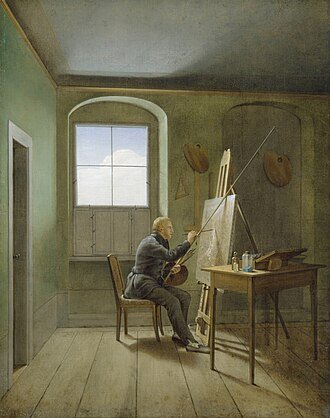
A portrait of the painter Caspar David Friedrich in his workshop, dated 1811 and executed in oil on canvas. The scene places the artist in the space where he worked, offering a glimpse of his everyday creative surroundings. The work is held at the Kunsthalle in Hamburg. Reliable details about its composition or commission are not available.
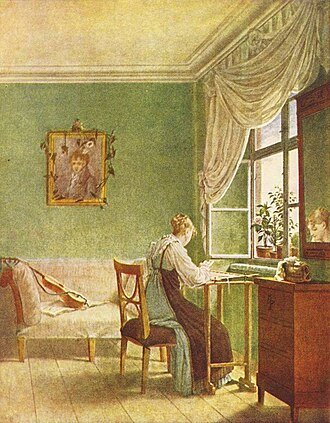
The painting shows a woman absorbed in embroidery within an intimate domestic scene. Dated 1812, it belongs to Romanticism and falls under genre painting, which focuses on everyday life. It is held at the Palace of Weimar. Little reliable information survives about its commission or its precise meaning.


Painted in 1829 by Georg Friedrich Kersting, this small oil on panel seems to depict, as its title suggests, life at a remote military outpost. Its modest size invites close, quiet looking rather than the sweep of a battle scene. It is held in Berlin's Alte Nationalgalerie, where visitors can study it at leisure.

The painting shows a figure absorbed in making a wreath, the activity that gives the work its title. Painted in oil on canvas in 1815, this small picture focuses on an everyday gesture and on the concentration of the task rather than on a dramatic episode. It is held by the Alte Nationalgalerie in Berlin.

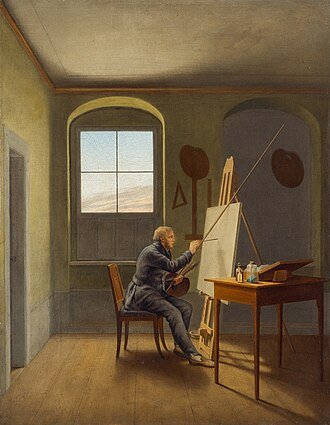
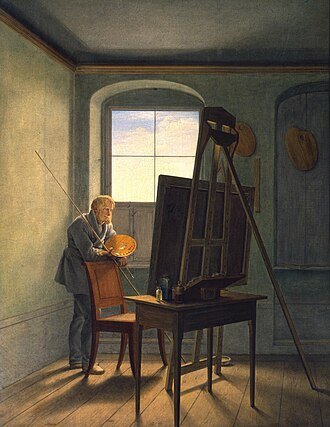
Kersting portrays Caspar David Friedrich in his studio in this intimate scene, painted in 1810 in oil on canvas. The roman numeral in the title suggests the subject was treated more than once. Now held by the Kunsthalle Mannheim, the picture presents the artist's workshop as a place of work, with the painter himself at its center.

Where to see the work
- Alte Nationalgalerie Berlin · 4
- Hamburger Kunsthalle Hamburg · 1
- Schloss Weimar Weimar · 1
- National Museum in Warsaw Warsaw · 1
- Kunsthalle Mannheim Mannheim · 1
- Kunsthalle Kiel Kiel · 1
Teachers and pupils
Pupils
- Julie von Egloffstein 1792–1869
Curiosities
A purchase urged by Goethe
In 1813 the painter Louise Seidler, a friend of Kersting, helped him send several of his works to Johann Wolfgang von Goethe. The writer was impressed and recommended that Grand Duke Charles Augustus buy The Embroiderer. A domestic studio scene thus reached the cultured circles of its day through the support of a famous poet.
A friend in uniform
Seidler described Kersting as "an altogether splendid and comical fellow", and she often served as his model. That closeness shows in the intimacy of his scenes. In 1813 he also painted a full-length self-portrait in the uniform of the volunteer Lützow rangers, the corps he served in during the war against Napoleon.