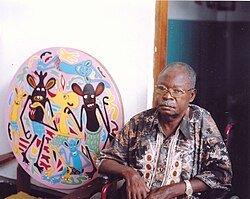
George Lilanga
1934–2005 · Makonde Tanzanian painter and sculptor
George Lilanga (c. 1934 - Dar es Salaam, 27 June 2005) was a Tanzanian painter and sculptor of the Makonde people and one of the best-known figures of late twentieth-century contemporary African art. He worked mainly in Dar es Salaam across sculpture, painting, printmaking, drawing, batik and metal works, and his career helped bring Tanzanian art to wider international attention.
According to his own account, he was born in the village of Kikwetu, in the Mtwara region of southern Tanzania, the son of a labourer on sisal plantations. He moved to Dar es Salaam in 1970. The following year he found work as a night watchman at the Nyumba ya Sanaa, a cultural centre devoted to African art and craft, where he met other artists and began experimenting with new supports. In 1982 he decorated wooden doors with shetani figures for the centre; the doors are now documented in a book.
His starting point was Makonde carving, especially the shetani figures, which he carried over into paintings on masonite, canvas, goatskin, batik and paper. His compositions, with vivid colours, bold outlines and flat backgrounds, show fantastical characters in humorous everyday scenes. From 1977 he exhibited in New York and Washington, and his work travelled to exhibitions in Africa, Europe, the United States, India and Japan, including Africa Remix.
From 2000, diabetes and other illnesses led to the amputation of both legs, yet he continued to paint with help from his studio until shortly before his death. His works are held in international collections of contemporary African art, and his visual language, rooted in Makonde art, influenced later generations of African artists.