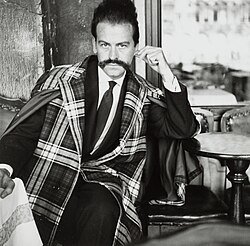
Georges Mathieu
1921–2012 · French painter and theorist of lyrical abstraction
Georges Mathieu (Boulogne-sur-Mer, 1921 - Boulogne-Billancourt, 2012) was a French abstract painter, art theorist and publicist, regarded as one of the fathers of European lyrical abstraction, a current within informalism. His importance lies in championing a painting based on rapid gesture and the absence of preexisting shapes, at a time when geometric abstraction dominated much of the artistic debate. Beyond painting, he was a member of the Académie des Beaux-Arts in Paris, and his work as a writer and cultural campaigner is reflected in his manifestos and public interventions.
He studied philosophy and law at the University of Lille and in 1944 produced his first non-figurative painting, Inception. After settling in Paris in 1947, he worked for an American shipping company and in 1948 staged a confrontation between French and American avant-garde painters, introducing French audiences to the work of Jackson Pollock.
His most personal contribution was the rapid improvisation of calligraphic strokes, which already appear in his work in the late 1930s. He considered painting a pure manifestation of being, the purer the faster it was executed. He therefore turned creation into a spectacle, painting large canvases in public at speed: a three-metre work in under an hour at the Sarah Bernhardt theatre in Paris, and a twelve-metre one in twenty minutes in Tokyo. These performances anticipated happenings and action painting.
His titles often draw on battles and episodes from French history, such as The Death of Philip the Bold (1952) and The Battle of Bouvines (1954). He joined the Académie des Beaux-Arts in 1976, and in 1978 the Grand Palais hosted a major retrospective. His legacy lies in his defence of lyrical abstraction as the latest revolution in the history of art, set against geometric abstraction and against movements such as Dada, which he criticised for their nihilistic character.