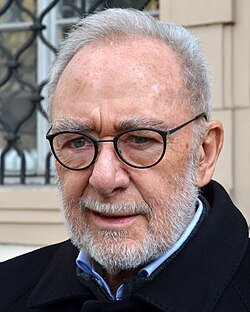
Gerhard Richter
1932– · German contemporary painter, figurative and abstract
Gerhard Richter (born 9 February 1932 in Dresden) is a German painter whose work runs through much of postwar painting: photo-based portraits, landscapes, gestural and colour-driven abstraction, and also glass and mirror pieces. He is one of the most expensive living artists on the market, and he has been called the greatest living painter and the Picasso of the 21st century. His career shows how an artist trained in East Germany became a central figure in Western art, and why his work is still debated.
Childhood between two regimes
Richter was born at the Dresden-Neustadt hospital, in the city often called the Florence of the Elbe, but he spent his childhood in the countryside. He grew up in Reichenau, now Bogatynia in Poland, and then in Waltersdorf in Upper Lusatia, where his father, Horst Richter, worked as a village teacher. Because of his job Horst was forced to join the Nazi Party, though he never became an enthusiastic supporter. When Gerhard was ten he was enrolled in the Deutsches Jungvolk, the preparatory organisation for the Hitler Youth.
The family moved to Waltersdorf in 1943, which spared them the bombing of Dresden. His father was called up to the Eastern Front and remained a prisoner until 1947. The episode that marked the young boy most was the death of his aunt Marianne, who had schizophrenia and starved to death in a psychiatric clinic as a victim of the Nazi euthanasia programme. This early encounter with death and with the violence of the period made him reject all ideology and develop a deep love of nature, a theme that returns in his landscapes.
Apprenticeship and academy in Dresden
Richter left school after the tenth grade and trained as a advertising and stage-set painter. In 1948 he finished a vocational school in Zittau and between 1949 and 1951 he worked as an apprentice sign painter and painter. His first application to the Dresden Academy of Fine Arts was rejected in 1950, reportedly as too bourgeois. The following year he was admitted, studying under Karl von Appen, Lohmar and Will Grohmann, and he graduated in 1956.
His student work was in mural painting. For the refectory of the Academy he produced Communion with Picasso (1955), and for his diploma he painted Joy of Life at the German Hygiene Museum. Both murals were painted over for ideological reasons after he fled to the West. After German reunification, sections of the second one were uncovered in the museum stairway, and they were covered again after 2000. In 1957 he married Marianne ‘Ema’ Eufinger. Years later he learned that her father, Heinrich Eufinger, had been involved in the sterilisation and eugenics programme of the Third Reich.
From official commissions to the flight West
Between 1957 and 1961 he worked as a master trainee at the Academy and took commissions from the state of East Germany. He painted murals such as Arbeiterkampf (Workers’ Struggle), oil portraits of the actress Angelica Domröse and of Ema, many self-portraits, and a large panorama of Dresden called Stadtbild (Townscape, 1956), a deliberately neutral title. This period gave him technical discipline, but it also showed him the limits the regime placed on art.
In 1961 he travelled alone to the Soviet Union. On his return he looked for Ema in Dresden, and the two crossed into West Berlin by the local train two months before the Wall was built. In West Germany they first lived in a refugee camp in Göttingen and then with Ema’s parents in Oldenburg. They finally settled in Düsseldorf, where Richter entered the Kunstakademie, attending until 1964, and where he later taught for many years.
Pop, capitalist realism and photo-painting
In Düsseldorf he befriended artists of his generation, including Sigmar Polke and Konrad Lueg. With them he introduced the term Capitalist Realism, a satirical variant of pop that borrowed the visual shorthand of advertising as an anti-style. The name also echoed Socialist Realism, the official doctrine of the Soviet Union, and commented on consumer culture in the Western capitalist system.
In 1962 he began painting from black-and-white photographs taken from newspapers, magazines, family albums and landscapes. His first exhibition in Düsseldorf, in 1963, presented this approach, which became known as photo-painting. Richter did not try to copy the photograph faithfully; he blurred the image so it looked like a badly focused snapshot, which kept it at a distance from history painting. For the series Forty-eight Portraits (1971–72) he chose faces of composers such as Gustav Mahler and Jean Sibelius and of writers such as Franz Kafka and H. G. Wells, a gallery that works almost as a catalogue of modern culture.
Constructivism, colour and glass
At the end of the 1960s Richter entered what he called a constructivist phase, in which his work became more theoretical. He made colour charts, paintings in which chance or a mathematical system determined the arrangement of colours, and sober grey monochromes. In 1967 he began using glass with Four Panes of Glass, plain sheets that could be tilted differently in each installation. In 1981 he made the first of his large transparent mirrors, which would reappear intermittently in his output.
His landscapes followed their own path. Landscape elements appeared in his work from 1963, but the independent series began in 1968 after a trip to Corsica. Critics relate these works to the German Romantic tradition and to Caspar David Friedrich, who also spent his formative years in Dresden. In 1972 the work Atlas, an archive of photographs and sketches, was first shown in Utrecht. It has grown over time to about 4,000 images grouped on roughly 600 panels.
Abstraction and the squeegee
From 1976 almost all of his production was abstract, though he never fully abandoned figuration. His method consists of brushing broad bands of primary colour onto the canvas and then adding layers, blurring and scraping them to conceal and reveal what lies beneath. From the mid-1980s he used a homemade squeegee to spread and scrape the paint, and in the 1990s he worked with ordered passes that produce vertical columns resembling a wall of planks. Richter has said that in this work he let things come rather than creating them.
Abstraction did not break with his older concerns. In 1988 he painted fifteen works titled 18 October 1977, based on press and police photographs of four members of the Red Army Faction. They were first shown in Krefeld in 1989. Much later, in 2014, he created the Birkenau cycle from Sonderkommando photographs taken at Auschwitz-Birkenau. In 2024 the cycle was displayed in a pavilion at Oświęcim/Auschwitz that he had designed.
Retrospectives, church glass and legacy
His international recognition came with honours such as the Golden Lion at the Venice Biennale and the Praemium Imperiale, both in 1997, and with the retrospective Gerhard Richter: 40 Years of Painting, curated by Robert Storr, which opened at MoMA in New York in 2002. In 2005 the Gerhard Richter Archive was established in Dresden in partnership with the artist and the State Art Collections. In 2007 his large window for Cologne Cathedral was unveiled: an abstract mosaic of about 11,500 squares in 72 colours, arranged at random by computer, recalling his 1974 painting 4096 Colours.
Richter still lives and works in Cologne, where he settled in 1983. His legacy lies in showing that photography can be both a source and a material for painting, that figuration and abstraction need not be opposites, and that painting can still raise questions about historical memory.
Curiosities
A mural that was covered again
Richter’s student murals were painted over after he fled to the West. After German reunification, two fragments of Joy of Life were uncovered in the stairway of the Hygiene Museum in Dresden. After 2000, however, those images were covered again by other works, so the mural returned to being hidden from public view.
An unexpected 11 September
In September 2001 Richter was due to fly to New York when the attacks of 9/11, including the one on the World Trade Center, forced his plane to be diverted to Halifax, Nova Scotia. A few years later he made one small painting specifically about the planes crashing into the towers. It is one of the few works in which he addresses a particular event so directly.
A controversial window
Richter designed the Cologne Cathedral window without a fee, and its cost was covered by donations from more than a thousand people. Cardinal Joachim Meisner did not attend the unveiling; he would have preferred a figurative depiction of 20th-century Christian martyrs and said the window would fit better in a mosque or another prayer house. Richter describes himself as a professed atheist with a strong leaning towards Catholicism.