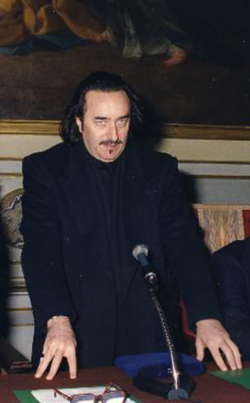
Gino De Dominicis
1947–1998 · controversial Italian artist, painter, sculptor and art theorist of the postwar period
Gino De Dominicis (Ancona, 1947 – Rome, 1998) was an Italian artist who described himself as a painter, sculptor, philosopher and architect. A controversial figure in postwar Italian art, his work cannot be placed within Arte Povera, the Transavanguardia or conceptual art. He cultivated an aura of mystery and avoided the press, to the point of refusing to have his works photographed. His first show took place at Rome's Galleria L'Attico in 1969, and in 1970 he published his Letter on Immortality, a theoretical statement of his research into time and physical immortality.
At the 1972 Venice Biennale he showed a work involving Paolo Rosa, a man with Down's syndrome seated in a room. His presence drew strong criticism, and the display was halted within the first day. The episode was discussed by Pier Paolo Pasolini and, a few years later, by Eugenio Montale in his Nobel Lecture.
From the 1980s he returned to painting, using tempera and gold on panel. His figures, often drawing on Gilgamesh and Urvasi, have elongated faces and out-of-proportion bodies. His last solo show was at Galleria Emilio Mazzoli in Modena in 1998, six months before his death. He is remembered above all for the 2010 retrospective at MAXXI in Rome.