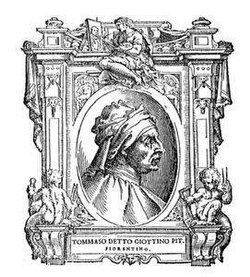
Giottino
1324–1372 · Florentine painter and sculptor of the Trecento, follower of Giotto
Tommaso di Stefano, known as Giottino, was an Italian painter and sculptor of the Florentine school, active in Florence during the fourteenth century. He matters because he was one of Giotto's closest followers. He absorbed the master's style so thoroughly that he received the nickname "little Giotto". According to some biographers he was the son of Stefano Fiorentino, a painter also linked to Giotto's workshop, and he trained by studying Giotto's works closely.
His career was brief, as he died of a chest illness at about the age of thirty-two. Vasari lists a long series of his frescoes. In 1340, after the expulsion of Walter of Brienne, Duke of Athens, he was commissioned to paint on the tower of the Florentine pedestal portraits of the duke and his ministers, with their family arms, as a mark of lasting disgrace; those paintings have been lost. His best-known ensemble in Florence is in the chapel of San Silvestro in Santa Croce, where three scenes from the life of Constantine decorate the right wall. They are badly damaged, but some heads of notable quality can still be seen. Other works are attributed to him in Assisi, along with several panels: a Deposition, a diptych with two episodes from the life of Saint Jerome in the Brera Museum in Milan, and a Glorious Virgin in Naples. Munich holds a Virgin with several saints. He is also credited with the prophets that adorn the campanile of Florence Cathedral, showing that he worked in sculpture as well.
His legacy lies in his pupils, among them Giovanni Toscani, and in Vasari's biography of him in his Lives of the Most Excellent Painters, Sculptors, and Architects.
Works (1)

Around 1360, Giottino painted this panel in tempera. It shows the dead Jesus surrounded by grieving figures, among them the Virgin Mary. The bodies gather around the lifeless figure, and sorrow comes across mainly through gestures and glances. The work is now held in the Uffizi Gallery in Florence.
Where to see the work
- Uffizi Gallery Florence · 1
Curiosities
A disgraceful portrait on a tower
In 1340, after Walter of Brienne, Duke of Athens, was expelled, Giottino was commissioned to paint on the tower of the Florentine pedestal the portrait of the duke and his ministers, with their family arms, as a sign of everlasting shame. Those paintings have disappeared, so the commission is known only from the texts that record it.
The father's nickname
His father, Stefano Fiorentino, was a celebrated painter in Giotto's school whose naturalism earned him the nickname "Scimmia della Natura", the Ape of Nature, for his perceived realism. Stefano instructed his son while Maso was studying the works of the great Giotto.
Disputed names and dates
The sources do not fully agree. One also calls him Tommaso Fiorentino and gives his activity as 1324 to 1369, while another places his death around 1372. His real name appears as Maso di Stefano or Tommaso di Stefano, which reflects the uncertainty about his early life.