
Giovanni Segantini
1858–1899 · Italian Symbolist and Divisionist painter, active in Switzerland
Giovanni Segantini (Arco, 1858 - Pontresina, 1899) was a nineteenth-century Italian painter associated with Symbolism and Divisionism. His alpine landscapes and allegorical scenes make him one of the most distinctive artists of his era. Born in Trentino, then under Austro-Hungarian rule, he came from a poor family. After his mother died in 1865, he was sent to work in Milan, where his brother introduced him to the art world. Between 1875 and 1879 he studied at the evening course of the Brera Academy.
During the 1880s his link to Divisionism and to Milanese painting grew stronger. In 1886 he moved to Savognin, in the Swiss canton of Graubünden, where he devoted himself fully to painting. There he worked on alpine landscapes and religious scenes with a fragmented, richly textured technique. Around 1889 he began to combine Divisionism with Symbolism through allegory. His most notable works date from 1887 to 1889, including the triptych on Life, Nature and Death, and paintings such as The Bad Mothers and Love at the Fountain of Life.
Segantini gained recognition late in life, with exhibitions at major art centres and public tributes in Switzerland. In 1894 he moved to Maloja, in the Engadine, seeking greater solitude. He died in 1899, aged 41, of peritonitis on the Schafberg above Pontresina, while his work was still developing.
His legacy lies in the blend of luminous colour, precise drawing and a view of nature that is both serene and unsettling. Though his technique recalls Seurat, his interest was not decorative, and his dramatic landscapes share affinities with Munch and Van Gogh.
Works (22)


Oil portrait dated 1897 and attributed to Giovanni Segantini. The record does not identify the sitter or explain the commission, so its original context cannot be specified. Its vertical, large format probably invites a frontal, solemn reading of the figure. The painting is held in the Collections of the Ospedale Maggiore.

Midday in the Alps belongs to the pastoral genre, with the Alpine landscape and mountain life at its centre. The midday hour suggests a scene of stillness and strong light set high among the peaks. Its atmosphere is the most direct way into the picture.

Judging by its title, the painting depicts an Alpine landscape in spring. Dated 1897, it is an oil on canvas now held by the J. Paul Getty Museum. Classed as a genre scene, it likely shows everyday life in the surroundings, though the available information is scarce.


A portrait of a young blonde woman painted by Giovanni Segantini in 1878 and held at the Galleria d'Arte Moderna in Milan. The record identifies the sitter as his wife Bice. The figure is shown directly, with attention centred on her face and bearing, which reflects the painter's interest in a specific, everyday female subject.

Giovanni Segantini painted this work in 1896, showing a couple beside a fountain that the title links to the source of life. Rather than a narrative scene, the image seems to present love as the origin of existence, a symbolic reading the title invites. The painting is held today in the Galleria d'Arte Moderna in Milan.

Giovanni Segantini's 1894 painting centres on an angel, the figure that gives the work its name and invites a symbolic reading. It is now held at the Galleria d'Arte Moderna in Milan. The available information does not clarify its commission or precise meaning, so specialist studies are the best place to explore it further.

Painted by Giovanni Segantini in 1886, this work shows a washerwoman beside a fountain, an everyday scene of rural labour. The simplicity of the subject invites attention to the woman's gesture and to the setting around the fountain. It is held in the Galleria d'Arte Moderna in Milan.

Painted by Giovanni Segantini in 1889, this work shows a mother alongside a cow, Bos primigenius taurus, set side by side as figures of care and motherhood. The title suggests a comparison between the two, both treated as mothers. Beyond this, little is documented here about its commission or reception, so any reading of its meaning should remain cautious.

Still life painted by Giovanni Segantini in 1884 and held by the Galleria d'Arte Moderna in Milan. The available record does not describe the objects depicted, their arrangement, or the circumstances of its making, so details of composition, possible symbolism and commission cannot be confirmed. As a genre, still life gathers inanimate objects and lets the painter focus on light, texture and colour.

Giovanni Segantini painted this oil on canvas in 1886. Its title, Ave Maria Crossing the Lake, suggests a scene of passage over water linked to the Ave Maria prayer, though the available information does not clarify its commission or the meaning the artist intended. It is held in the Museo Segantini.

This oil on canvas by Giovanni Segantini, dated 1896, carries the title Life. Its wide, landscape format and considerable size suggest a broad scene, though its subject is not described in detail. It is held by the Segantini Museum, devoted to the artist, making it a key place to study his work.

A large horizontal canvas by Giovanni Segantini, painted in oil in 1897. Its panoramic format and title suggest a focus on the landscape and on the relationship between people and the natural world, though little more is known about the scene. It is now kept in the Segantini Museum, devoted to the artist.

Large oil on canvas dated 1896 by Giovanni Segantini. Its title, Death, points to a funereal theme treated on a monumental scale, and its wide horizontal format invites the viewer to take in the whole scene at once. Without further documentation, the specific scene and the circumstances of its commission cannot be stated with certainty. The painting is held by the Gottfried Keller-Stiftung.

A woman rides a sled down a snowy slope, with a village in the mountains beyond. Snow fills much of the canvas, and the Alpine landscape frames a simple scene of life at high altitude. Segantini painted it in oil on canvas in 1890, and it is now shown in the Segantini Museum.

Painted by Giovanni Segantini in 1883, in oil on canvas, this work shows bagpipers in the Brianza area, a district of Lombardy near Milan. Little is known about its commission or reception, so the painting is best read through what it shows: figures of popular musicians set in a rural landscape.

This 1889 oil painting shows a winter landscape in which a small cluster of houses stands out against a wide expanse of snow, with mountains in the background. Segantini painted it in Savognin, a village in the Swiss Alps, and the focus lies on the stillness of the scene rather than on any anecdote. The work conveys the silence and cold light of a snowbound mountain setting.
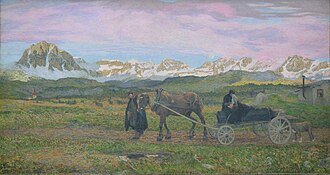
Painted in 1895 by Giovanni Segantini, this large horizontal canvas, about three metres wide, is held in Berlin's Alte Nationalgalerie. Its title, Returning Home, points to a theme of homecoming, though the available information does not specify the scene or the figures it shows. For a fuller reading of its meaning, the museum's catalogue or studies of the artist's output are the best place to look.

Where to see the work
- Galleria d'arte moderna di Milano Milan · 7
- Segantini Museum (Building) St. Moritz · 4
- Belvedere Vienna · 1
- Walker Art Gallery Liverpool · 1
- J. Paul Getty Museum Los Angeles · 1
- Kunsthaus Zürich District 1 · 1
- National Museum of Western Art Tokyo · 1
- Alte Nationalgalerie Berlin · 1
- Cleveland Museum of Art Cleveland · 1
Curiosities
A changed surname
According to the sources, the family appeared as Segatini, and the painter later changed the surname himself. The detail reflects his wish to build a personal identity. Something similar happened with his nationality: in the year his mother died he asked to renounce Austrian citizenship, but he did not obtain Italian citizenship, so he remained stateless for the rest of his life.
A famous nephew
Segantini was the uncle of sculptor Rembrandt Bugatti and of entrepreneur Ettore Bugatti, two names linked to the arts and to industry. The sources record this family connection, though they do not detail how it influenced either of their careers.