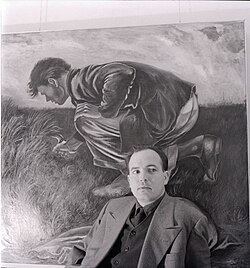
Giuseppe Zigaina
1924–2015 · Italian neorealist painter and essayist
Giuseppe Zigaina (Cervignano del Friuli, 1924 – Palmanova, 2015) was an Italian painter of the twentieth century and one of the leading figures of Neorealism in the Friuli-Venezia Giulia region. He also wrote essays, but his importance lies mainly in his paintings.
After enrolling in 1944 at the Venice Academy to study architecture, he turned around 1945 toward Neorealism, drawing on the post-Cubism of Picasso and German Expressionism. In 1946 he befriended Pier Paolo Pasolini, a friendship that proved decisive for his career. From the 1950s he exhibited in Italy and across Europe, and took part in the São Paulo Biennial and the Venice Biennale. His best-known work of this period, Assemblea dei braccianti sul Cormor, was shown at the 1952 Venice Biennale and is regarded as a key Neorealist work for its portrait of farm labourers.
In the late 1950s his painting turned to industrial civilisation, with a subtle and critical pessimism, and later the figure of the father became a recurring theme. In the 1980s series such as Verso la laguna he used a bird's-eye perspective. He received international prizes in the 1990s and taught at the Art Institute of San Francisco. His legacy rests mainly on his vision of rural life and on his relationship with Pasolini.