Gong Kai
1222–1307 · Chinese painter, poet and official of the late Song dynasty
Gong Kai (1222-1307) was a Chinese painter, poet and official who lived through the last years of the Song dynasty. Born in Huaiyin, in present-day Jiangsu Province, he failed the examinations needed for high office and served as a minor official in the Board of Salt Revenues. After the Mongol conquest and the rise of the Yuan dynasty, he became a scholar-amateur painter, and his family survived in poverty by selling his work.
His plain style, with coarse brushwork, departed from the professional painting of his day. He is best known for his horses, above all Jun Gu, a Noble Horse, an ink painting on a paper handscroll that many read as a metaphor for the fallen dynasty and for the artist himself. His other celebrated work is Zhong Kui Traveling, in which the demon-queller travels with his sister and a procession of demons, a scene probably carrying a political message. Paintings of Cai Wenji held at the Freer Gallery in Washington are tentatively attributed to him. His legacy lies in his place among the scholar-amateur painters who flourished under the Yuan.
Works (1)
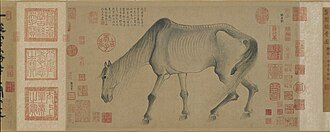
A silk painting showing a horse of very lean body, with its ribs and bones clearly outlined. The choice of an emaciated animal suggests close attention to its physical condition rather than to beauty or strength. The work is attributed to Gong Kai and is held at the Osaka City Museum of Fine Arts.