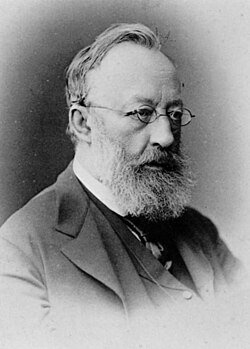
Gottfried Keller
1819–1890 · Swiss landscape painter who later became a German-language writer
Gottfried Keller (Zurich, 1819-1890) is remembered today mainly as a novelist and poet in German, but his first vocation was painting. Born in Zurich during the Napoleonic upheavals, he trained as an apprentice to landscape and watercolour painters in his home city, and that discipline of the eye shaped his outlook for the rest of his life. Among the works attributed to him is Heroic Landscape (1842), a plainly executed landscape that reflects the craft he had learned in the studio.
Between 1834 and 1837 he apprenticed with the landscape painter Steiger and then with the watercolourist Rudolf Meyer. In 1840 he went to Munich to study at the Royal Academy of Fine Arts, a training that gave him a trade without securing a steady career. Back in Zurich in 1842, despite his talent, he gradually moved away from the brush. His biographer Hartmann describes those years as almost inactive, marked by a strong pull toward radical politics.
His stays in Heidelberg and Berlin, from 1848 to 1856, proved decisive. In Heidelberg he came under the influence of the philosopher Feuerbach, and in Berlin he settled on literature as his career. There he wrote the semi-autobiographical novel Green Henry (Der grüne Heinrich), which grew out of his youth as a would-be painter and reached a rounded form in its second version of 1879. He also published Seldwyla Folks, stories of Swiss village life.
Back in Zurich he served as First Official Secretary of the canton from 1861 to 1876, and afterwards lived as a bachelor with his sister Regula. His reputation rests on fifteen short stories and on his collected poetry of 1883, yet his early years as a painter help explain the precision with which he describes landscape and everyday life.
Works (1)

Curiosities
A foundation named after a writer
Shortly before her own death in 1890, Lydia Escher (1858-1891) placed the Escher family fortune into a foundation named after Keller, whose work her father had supported. It was established on 6 June 1890 and managed by the Swiss Federal Council. Its original aim included promoting the independent work of women, especially in the applied arts, but at the urging of Emil Welti that purpose was left out of the founding deed. Today, based in Winterthur, the foundation has become an important collecting institution.
Romeo and Juliet in a Swiss village
One of his stories, Romeo and Juliet in the Village, transplants Shakespeare's plot into a Swiss village and is regarded by Hartmann as one of the most pathetic tales in literature. Hartmann also judges The Three Honest Comb-Makers the most scorching attack on petit bourgeois morality ever written by any author. Both stories appear in his first collection of tales, published after the revolutions of 1848.