
Gu Kaizhi (c. 344-406) was one of the most celebrated painters of ancient China and a key figure for understanding art in the Eastern Jin dynasty (317-420). Born in Wuxi, in what is now Jiangsu province, he began painting in Nanjing around 364. His courtesy name was Changkang. Besides painting, he was a talented poet and calligrapher, and he held official posts: in 366 he became an officer under the Grand Marshal and was later promoted to royal officer, although his political career remains secondary to his art.
He wrote three books on painting theory: On Painting, Introduction of Famous Paintings of the Wei and Jin Dynasties, and Painting Yuntai Mountain. In them he argued that in figure painting clothing and outward appearance mattered less than the eyes, which he regarded as the spirit and the decisive element of a likeness.
Today his work is known only through silk handscroll copies attributed to him, most of them made long after his death. The best known include Admonitions of the Instructress to the Court Ladies, a political satire in nine scenes about Empress Jia Nanfeng; Nymph of the Luo River, based on a poem by Cao Zhi; and Wise and Benevolent Women, a five-metre scroll divided into ten sections. Many of these works are now held in museums abroad, which makes it difficult to trace his original paintings.
His legacy lies mainly in his theory and in the style visible in these copies, with fine brushlines and calm faces. His views on portraiture shaped later discussions of how painters should represent people, and his name became a reference point in Chinese art history.
Works (3)
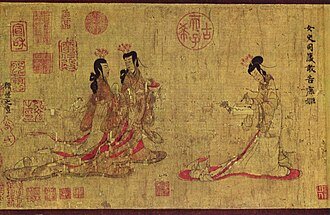


The painting is attributed to Gu Kaizhi and dated to around 350. It is executed on silk, a fragile support that requires careful conservation. Its title refers to wise and virtuous women, a moral theme common in early Chinese painting. Today it is held in the Palace Museum in Beijing.
Where to see the work
- British Museum London Borough of Camden · 1
- The Palace Museum Beijing · 1
Curiosities
A sealed box and a theft
According to the tradition recorded in the sources, Gu entrusted Emperor Huan Xuan, an enthusiastic art collector, with a sealed chest holding his most precious works. The emperor opened it, kept the paintings and returned the chest with the seals intact. On discovering the loss, Gu remarked that the marvellous works had partaken of divine power, transformed themselves and vanished, like men ascending to join the immortals.
Two versions of the Admonitions
The copy of the Admonitions held in Beijing, dating to the Song dynasty, is the complete version with twelve scenes. The one in the British Museum, probably an early Tang copy, lacks the first three scenes and has been in Britain since it was looted during the Boxer Uprising in 1900. Both versions illustrate the same satire by Zhang Hua.
A copy bought in 1930
One of the five known copies of Nymph of the Luo River was bought by the British Museum in 1930. It is generally dated to the Ming dynasty, showing that the subject continued to be copied long after Gu's time. Other copies are spread across Beijing, Taipei and Washington, and one was recovered in Liaoning after disappearing in 1945.