
Gustave Doré
1832–1883 · French Romantic illustrator, painter and sculptor
Paul Gustave Doré (Strasbourg, 6 January 1832 - Paris, 23 January 1883) was a French artist who worked as a painter, sculptor and illustrator. He is best known for his wood engravings, which brought him international fame, and in France he is regarded as the last of the great illustrators. Across the nineteenth century he was one of the most widely known illustrators in the world. His images for the Vulgate Bible and Dante's Divine Comedy, and for Cervantes's Don Quixote, shaped how generations of readers, artists, and stage and film directors pictured those texts, and remained the classic reference until well into the late twentieth century. Although he is remembered chiefly for his prints, Doré saw himself, and was seen by many of his contemporaries, as a painter, and his pictures also sold well.
Early years in caricature
Born in Strasbourg, Doré signed a contract with Charles Philipon when he was fifteen, agreeing to supply one lithograph a week. He began working as a caricaturist for the French paper Le journal pour rire, and the work of J. J. Grandville is often cited as an influence on his early style. Wood engraving was his main technique at the time. In the late 1840s and early 1850s he also produced text comics such as The Labours of Hercules (1847), Trois artistes incompris et mécontents (1851) and L'Histoire de la Sainte Russie (1854), which already showed his taste for visual storytelling and satire.
Commissions from literature
His first major commissions came from classic texts. He was asked to depict scenes from Rabelais, Balzac and Dante, and while still very young he was earning more than his contemporary Honoré Daumier. In 1853 he illustrated the works of Lord Byron, which opened the door to other English-language authors, among them Edgar Allan Poe, whose poem The Raven received an oversized illustrated edition. He also worked on Cervantes. His French edition of Don Quixote, made in the 1860s, gave the knight and his squire Sancho Panza a look so memorable that later readers, painters, and stage and film directors adopted it. His illustrated Bible of 1865 was another great success and served as a calling card in London, where a large exhibition of his work led to the founding of the Doré Gallery on New Bond Street.
A journey through Spain
In 1862 he travelled through Spain with the baron Charles Davillier. The journey produced a series of illustrated travel accounts on Valencia, Galicia, Andalusia and Murcia, with stays in Granada, Madrid and other Spanish cities, which appeared the following year in the series Le Tour du Monde. The trip left a clear mark on his imagery. Spanish landscapes, local types and customs became one of the routes by which much of Europe came to know mid-nineteenth-century Spain. His direct experience of the country also gave weight to his later Cervantes illustrations, which rest on a real knowledge of the geography they describe.
London and the portrait of a city
In 1869 Blanchard Jerrold suggested that he join him in producing a full portrait of London, drawing on The Microcosm of London by Rudolph Ackermann, William Pyne and Thomas Rowlandson, published in three volumes between 1808 and 1810. Doré signed a five-year contract with the publisher Grant & Co, which required him to spend at least three months a year in the city, and he was paid £10,000 a year for the project. The result, London: A Pilgrimage, with 180 wood engravings, appeared in 1872. It sold well, but several critics were uneasy about its frank depiction of poverty in parts of the city. The Art Journal accused him of inventing rather than copying, and the Westminster Review complained that his sketches dwelt on the commonest, vulgarest outward features. Still, the book's success led British publishers to commission more work from him, including illustrations for Milton's Paradise Lost, Tennyson's Idylls of the King, The Works of Thomas Hood and The Divine Comedy. His drawings also appeared regularly in The Illustrated London News.
Painting, sculpture and legacy
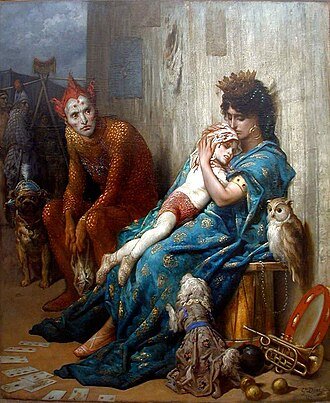
About 150 paintings by Doré are catalogued, many of them on a large scale. His painting is marked by a calculated naturalism, close attention to texture and a leaning towards chiaroscuro, with clear traces of Spanish Baroque influence. The largest of his canvases, Christ Leaving the Praetorium, measures roughly six by nine metres and is held by the Musée d'Art moderne et contemporain in Strasbourg. Other notable works include Andromeda, in the Chimei Museum in Tainan, Taiwan, and Flower Sellers of London, in the Walker Art Gallery in Liverpool. He also worked as a sculptor, and his monument to Alexandre Dumas père stands in Paris.
In his wood engravings Doré imagined a startling and feverish Middle Ages, full of gloomy forests, ruins and chaotic crowds. This late Romantic vision was more pronounced in his work than in that of many of his peers, and his sweeping landscapes, with echoes of John Martin, reveal an interest in the sublime linked to Burke's theories. He died of a heart attack in Paris after a short illness and was buried in the Père-Lachaise Cemetery. Writers such as Théophile Gautier and H. P. Lovecraft admired him, and he is said to have declared that he would illustrate everything.
Works (16)


Oil on canvas by Gustave Doré, dated 1871, belonging to the tradition of religious history painting. It depicts Christian martyrs, a subject frequently addressed in nineteenth-century art. Without further references, the commission and the circumstances of its making cannot be established with certainty.
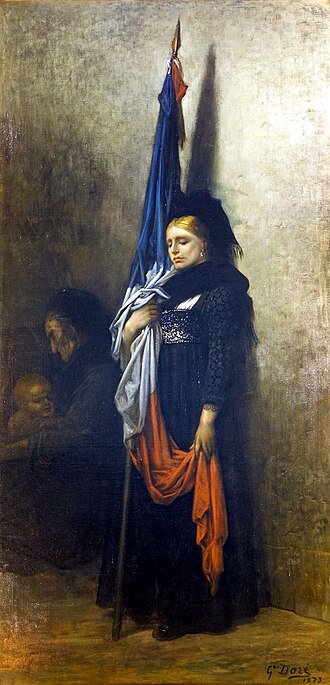
This 1872 allegory by Gustave Doré shows a woman as a personification of Alsace, a region placed under German rule after the Franco-Prussian War. The painting is held in Colmar, and its title, "L'Alsace meurtrie" (Alsace wounded), suggests the mood of grief and suffering the artist intended to convey. With the available information, no further details about its composition or reception can be confirmed.

Gustave Doré painted this oil on canvas in 1865, showing Tobias as the central figure in a religious subject drawn from the biblical story that bears his name. The available material says nothing about who commissioned it or how the scene was received, so any reading of the composition should stay cautious. The painting is held by the Musée Unterlinden.

Gustave Doré painted this scene in 1866, drawing on the theme of the fall of the rebel angels, a subject from Christian religious imagery. The composition arranges a mass of figures tumbling and tangled within a vertical space, where strong contrasts of light and shadow dominate. No further details about its commission or reception are recorded, so it is best to limit the description to what is visible in the painting.

Painted by Gustave Doré in 1862, this oil on canvas takes the tale of Little Red Riding Hood as its subject. Without reference texts clarifying its commission or context, it is best to stay with what is visible: a forest setting and figures that recall the popular story. Its horizontal format and painterly handling show the artist's interest in narrative scenes.

Mountain landscape painted by Gustave Doré in 1870, an oil on canvas of large format. The work focuses on a mountainous terrain that dominates the scene, and its composition invites the viewer to contemplate the vastness of the land. Since no further documentation is available, it is best to describe it cautiously and avoid assigning a commission or a specific intention that is not on record.

Where to see the work
- Strasbourg Museum of Modern and Contemporary Art Strasbourg · 3
- Museum of Fine Arts of Nancy Nancy · 2
- Musée d'Art Roger-Quilliot Clermont-Ferrand · 1
- Musée d'Orsay Paris · 1
- Musée municipal de Bourg-en-Bresse Bourg-en-Bresse · 1
- Musée des Beaux-Arts de la ville de Paris Paris · 1
- National Museum of Western Art Tokyo · 1
- Unterlinden Museum Colmar · 1
- National Gallery of Victoria City of Melbourne · 1
Teachers and pupils
Pupils
- Édouard Riou 1833–1900
Curiosities
Puss in Boots
One of his most influential works in popular culture is his redesign of Puss in Boots, which he turned into a swashbuckling cape-and-sword hero for a new edition of Charles Perrault's fairy tale. Although his role is rarely acknowledged, this design directly inspired the character of the same name in several Shrek films and in the spin-off Puss in Boots. A wood engraving from the nineteenth century thus still shapes animated characters seen by audiences today.
Forty block-cutters for one artist
Doré designed the images on paper, but other craftsmen cut his drawings into the wooden printing blocks. At the height of his career some forty block-cutters worked for him, and they usually signed the finished image as well. His most important illustrations were copied by electrotype, a process that allowed very large print runs to be published at the same time in several countries.
Thirty thousand francs for The Raven
In 1883 the publisher Harper & Brothers paid Doré 30,000 francs for his oversized illustrated edition of Edgar Allan Poe's The Raven. The commission shows how valuable his name had become as a commercial draw near the end of his life, since the poem and its plates were sold as a large, luxurious edition.
A London scene that caught van Gogh's eye
Some of Doré's bleak images of London poverty had a long afterlife. Newgate Prison: The Exercise Yard, one of these grim scenes, fascinated Vincent van Gogh, who painted a version of the subject in 1890, the year of his death. While some British critics rejected the engravings, the Dutch painter clearly kept them in mind.