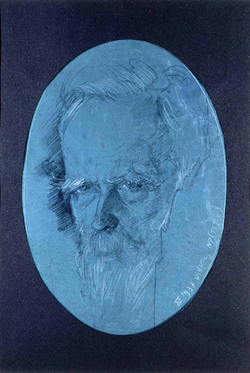
Hans Cornelius
1863–1947 · German philosopher, psychologist and painter
Johannes Wilhelm Cornelius, known as Hans Cornelius (Munich, 1863 – Gräfelfing, 1947), was a German neo-Kantian philosopher and psychologist. Although he trained in chemistry and worked mainly in philosophy, he also painted and sculpted, and he developed a theory of aesthetics and an approach to art education.
He earned a doctorate in chemistry in 1886 before turning to philosophy. After habilitating in 1894, he taught in Munich and, from 1910, at Frankfurt, where he retired in 1928. His thinking drew on Ernst Mach's theory of knowledge and on Kant's transcendental philosophy, which he aimed to radicalise by analysing consciousness. He supervised the doctoral work of Max Horkheimer and Theodor W. Adorno. Politically he opposed the First World War, joined the SPD in 1918 and promoted a European confederation.
His legacy lies mainly in the training of Horkheimer and Adorno, and in his writings on aesthetics and art education, such as Elementargesetze der bildenden Kunst.