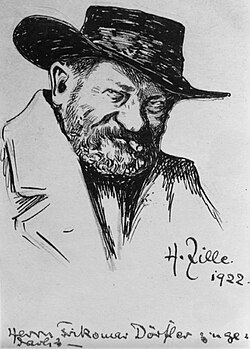
Heinrich Zille
1858–1929 · German illustrator, caricaturist and photographer of Berlin
Heinrich Zille (Radeburg, near Dresden, 1858 – Berlin, 1929) was one of the most popular illustrators of Imperial and Weimar Germany. His drawings, many of them published in the satirical weekly Simplicissimus, portrayed the lives of ordinary Berliners with humour and without idealisation, and he is regarded as a visual chronicler of urban poverty in his time.
He was born into a family of craftsmen. His father, a watchmaker with technical skill, suffered debts that forced the young Zille to spend long periods with his grandmother. In 1867 the family moved to Berlin, where he finished school in 1872 and, after an early interest in drawing lessons, began an apprenticeship as a lithographer. That trade gave him the working methods he later used for his own prints.
In 1883 he married Hulda Frieske, with whom he had three children; she died in 1919. His work centred on the tenants of the Mietskasernen, the large Berlin tenement blocks where up to a dozen people sometimes shared a single room. Zille depicted beggars, prostitutes, labourers and above all the children of these districts, who met their hardships with resourcefulness and refused to give up. Although he saw himself as a hard-working craftsman rather than a real artist, Max Liebermann supported him: he invited him into the Berlin Secession in 1903 and encouraged him to live from his drawings when he lost his job as a lithographer in 1910.
His recognition came late. In 1921 the National Gallery bought some of his drawings, in 1924 the Academy of the Arts gave him a professorship, and in 1928 his seventieth birthday was celebrated across Berlin. He died the following year and was buried at the Stahnsdorf South-Western Cemetery. After his death his name became attached to several places in the city, including Heinrich Zille Park in Mitte and a museum opened in the Nikolaiviertel in 2002. His legacy lies in the image he gave of working-class Berlin and in his influence on the cinema of the period, as the 1925 film Die Verrufenen was based on his characters.