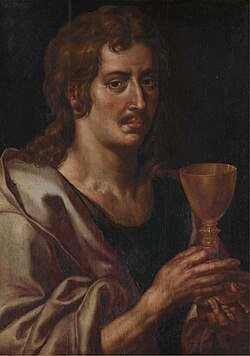
Hendrick de Clerck (c. 1560 - 27 August 1630) was a Flemish painter active in Rome and Brussels in the late sixteenth and early seventeenth centuries. He belongs to the late Mannerist generation that preceded Peter Paul Rubens and the Flemish Baroque. His work resembles that of Maerten de Vos, though it lacks the same power. His training is uncertain, and he may have studied with Joos van Winghe in Brussels and Maerten de Vos in Antwerp. Drawings of scenes in Rome, Tivoli and Naples suggest a stay in Italy in the late 1580s.
He served as court painter to the governors of the Spanish Netherlands, first to Archduke Ernest and, after Ernest's death in 1596, to Albert and Isabella. His paintings promoted the couple's ambitions for the imperial crown, showing them as Roman gods, Christian saints and wise rulers. He designed some of the temporary decorations for Albert's Joyous Entry into Brussels in 1596. He also painted altarpieces for Brussels churches that had been lost during the iconoclastic disturbances of 1566, in a clear Counter-Reformation style. He specialised in small cabinet paintings of biblical, allegorical and mythological subjects, often painting the figures while other artists, such as Denis van Alsloot and Jan Brueghel de Velours, painted the landscapes. The Prado holds four of his works. After 1612 his courtly style fell out of favour beside the new art of Rubens, and he faded into obscurity. His son Jacob also became a painter.
Works (2)
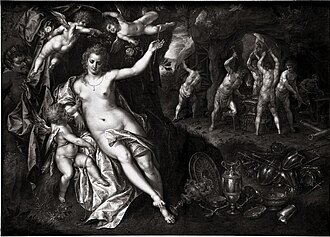

A religious painting by Hendrick de Clerck, dated 1614 and executed in oil on panel. It depicts the Adoration of the Magi, a gospel scene that was widely treated in painting at the time. The available information does not allow us to say more about its commission or composition.
Where to see the work
- Suermondt-Ludwig-Museum Aachen · 1
- Musées Nationaux Récupération · 1