Hendrik-Frans De Cort
1742–1810 · Flemish landscape painter and draughtsman known for topographical views of English and Welsh estates
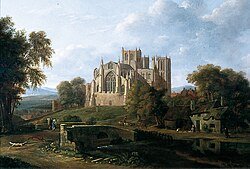
Hendrik-Frans De Cort (Antwerp, 1742 – London, 28 June 1810) was a Flemish landscape painter and draughtsman whose career took him from Antwerp to Paris and, above all, to England and Wales. He is chiefly remembered for his topographical paintings and drawings of English castles, country houses, parks and ruins, a body of work that earned him a successful practice among the British nobility and places him in a long line of Flemish painters who worked on English estates.
He trained in Antwerp with Henricus Josephus Antonissen and Willem Jacob Herreyns and became a master of the Antwerp Guild of Saint Luke in 1770. In 1774 Archduke Maximilian Francis of Austria appointed him his personal painter, and after 1776 he settled in Paris, where he was received into the Académie royale de peinture et de sculpture in 1779. He worked as ordinary painter to Louis Joseph, Prince of Condé, for whom he painted views of the Château de Chantilly in 1781. Back in Antwerp in 1782, he co-founded the Konstmaatschappij in 1788, but he left Flanders after the Brabant Revolution of 1789 and settled in London around 1790.
His landscapes combine precise topography with an Italianate composition indebted to Gaspar Dughet. He often worked on specially prepared mahogany panels, building up light grounds, outlines in graphite and layers of oil glazes, a method the painter Joseph Farington described in detail. He could also bend the facts for effect: in his view of Launceston Castle in Cornwall, he placed the main towers behind other buildings, although they would not normally have been visible from that viewpoint. His preparatory wash drawings are held by the British Museum and the Ashmolean Museum, and Antwerp's Stedelijk Prentenkabinet keeps a sketchbook of his castle studies from his years in Flanders.
In England he exhibited at the Royal Academy and the British Institution between 1790 and 1806. His legacy lies in the visual record he left of English and Welsh castles, houses and landscapes, many of which have since changed or disappeared.
Teachers and pupils
Studied with
- Willem Jacob Herreyns 1743–1827