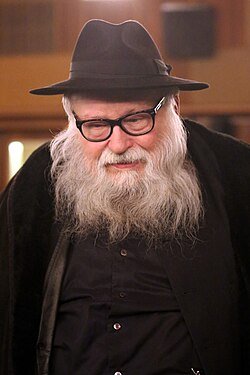
Hermann Nitsch
1938–2022 · Austrian painter, writer and composer, a precursor of Viennese Actionism
Hermann Nitsch (Vienna, 1938 - Mistelbach, Austria, 2022) was an Austrian painter, writer and composer, regarded as one of the leading figures of Viennese Actionism. His importance lies in bringing painting into the realm of staged action, combining theatre, music and ritual, and in placing the body and symbolic violence at the centre of his work.
He trained in painting at the Wiener Graphische Lehr- und Versuchsanstalt, where he became drawn to religious art. In the late 1950s he conceived the Orgien Mysterien Theater (roughly, Theatre of Orgies and Mysteries), a project of collective actions involving animal carcasses, entrails and blood, and sometimes sacrifices. Between 1962 and 1998 he staged around a hundred of these performances. The cloths and bandages used in them suggested to him the idea of making paintings, and his abstract splatter works grew out of the same reflection on what it means to be human.
In 1966 he took part in the Destruction in Art Symposium in London, alongside Gustav Metzger, Wolf Vostell and Juan Hidalgo, and in 1972 he appeared at Documenta 5 in Kassel. From 1971 he organised his Orgy-Mystery Games at Prinzendorf Castle, where the 100th action in 1998 lasted six days without pause. His work also reached the opera house, with sets and costumes for productions of works by Massenet, Glass, Stravinsky, Schumann and Messiaen. His ideas, it has been noted, drew on influences from Sade, Nietzsche, Freud and Artaud.
His work was highly controversial. Animal rights activists, theologians and defenders of public morality criticised it, and he faced several court cases for public indecency, some of which ended in prison sentences. Some former colleagues distanced themselves from what they saw as its overly religious character. In his final years he turned to bright colours and floral motifs, such as peonies. Today museums in Mistelbach and Naples are dedicated to his work, which continues to provoke debate about violence and its representation in art.