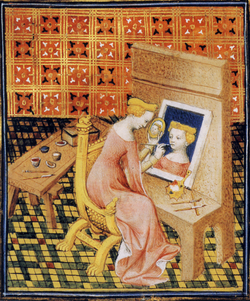
Iaia of Cyzicus, also known as Marcia, was a Greek painter who lived in the time of Marcus Terentius Varro (116-27 BC). Born in Cyzicus, a city of the Greek world that later belonged to the Roman Empire, she is regarded as one of the few women artists of antiquity whose name has survived. Her birth is dated to about 99 BC in the reference data, although the sources do not establish this date with certainty.
She worked as a panel painter and also as an ivory carver. Most of her paintings are said to have depicted women. Among the works attributed to her are a large panel of an old woman and a self-portrait, though these attributions rest on the tradition transmitted by Pliny. She was remembered for painting quickly and better than her male rivals, Sopolis and Dionysius, which allowed her to earn more than they did. She probably came to Rome to meet the demand for art there in the late Republic, and she remained unmarried all her life.
Pliny the Elder included her in his Natural History among the few female artists of antiquity he records, and Boccaccio later included her in De mulieribus claris under the name Marcia, possibly confusing her with a Vestal Virgin of that name. Her figure has reappeared in Steven Saylor's novel Arms of Nemesis and in works by the Italian writer Sabrina Gatti, and her name appears on Judy Chicago's Heritage Floor.