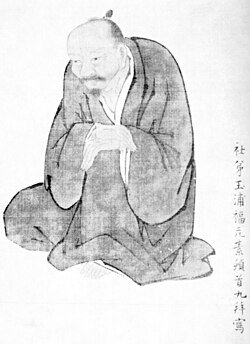
Ike no Taiga
1723–1776 · Japanese painter and calligrapher of the Edo period
Ike no Taiga (池大雅, Kyoto, 1723–1776) was a Japanese painter and calligrapher of the Edo period, one of the leading figures of bunjinga, also called nanga, or literati painting. Together with Yosa Buson he perfected this genre, which drew on classical Chinese culture and painting techniques, while also bringing some newer methods into an approach that looked very traditional.
Born into a poor family, he lost his father at the age of three, and his widowed mother was nevertheless able to give him a solid education in both Japanese and Chinese disciplines. By about fourteen he was working as a professional artist in Kyoto, painting fans and engraving seals. An encounter with Yanagisawa Kien, a prominent social and artistic figure of the time, introduced him to the bunjin world, and from 1738 he studied painting and calligraphy with him.
After a period of travel through Kanazawa, Nikkō and Mount Fuji, he spent some time in Edo. His journeys, often undertaken with fellow literati, were a way of seeking inspiration in nature. Together with Buson he illustrated the Jūben jūgi-jō (1771), an album celebrating a life of simple pleasures that is now regarded as an exemplary expression of bunjin philosophy. Later, after returning to Kyoto, Hakuin Ekaku left a mark on his style.
His legacy lies in both his works and his example as a literati artist. Some of his paintings have been designated National Treasures of Japan.
Teachers and pupils
Studied with
- Ki-en 1703–1758
Pupils
- Sonsai 1736–1802