
Jacopo Bassano, born Giacomo da Ponte (c. 1510 - 13 February 1592), was an Italian painter of the Venetian school, traditionally associated with Mannerism. He was born and died in Bassano del Grappa, a small town near Venice that gave him his artistic surname. He matters because he gave religious painting a rural character, filling biblical scenes with peasants, animals and farming landscapes, a feature that anticipated elements of later Baroque naturalism.
He trained in the workshop of his father, Francesco the Elder, a painter of local reputation. As a young man he also learned practical skills in surveying, mapmaking and engineering, which helps explain his interest in the landscape of the Veneto. In the 1530s he worked in Venice, where he could study the work of Titian and Pordenone, and where he may have been taught by Bonifazio de' Pitati. After his father died in 1539 he returned to Bassano, married a local woman, Elisabetta Merzari, in 1546, and took charge of the family workshop.
His style developed from an early phase of intense colour, seen in The Supper at Emmaus (1538), towards pastoral subjects from the late 1550s onwards. Among his best-known works are The Animals Entering Noah's Ark, in the Prado, The Return of Jacob to Canaan, Dives and Lazarus, Actaeon and the Nymphs, The Last Supper and The Annunciation to the Shepherds. In the final decades of his career he became one of the first artists to paint nocturnes, night scenes lit by artificial light, which proved very popular with local audiences.
His sons Francesco the Younger, Giovanni Battista, Leandro and Girolamo continued the workshop and imitated his manner closely, so it is now hard to attribute some works with certainty to one hand or another. His legacy lies in integrating rural genre scenes into religious painting, and his pictures circulated first in Venice and then widely across Europe.
Works (23)

Two hunting dogs fill the foreground with little narrative beyond their presence. One is a pointer, and both stand in a simple outdoor setting of tree trunk, rope, small plant and open sky. Painted in 1548 by Jacopo Bassano of the Venetian school, the picture treats the animals themselves as its real subject.

Painting by Jacopo Bassano dated 1546, executed in oil on canvas on a large scale. It belongs to religious art and depicts the Gospel episode of the Last Supper. Without further references, it is best described cautiously: its wide format suggests a scene meant to be seen from a distance, and its interest lies in how the painter arranges the diners around the table.

This work by Jacopo Bassano, dated 1555, shows the Virgin Mary with the Christ Child receiving the visit of the Magi, a common subject in religious painting. The scene is organised around the connection between the figures and the offering of the visitors. For details about its commission or history, specialised sources are worth consulting.

Jacopo Bassano painted this canvas in 1556 within the Venetian school. It shows Jerome absorbed in meditation, a subject common in religious art. Executed in oil on canvas, the work is held at the Venice Academy Gallery. The available information does not clarify its commission or further details of its composition.

This work by Jacopo Bassano, dated 1538 and painted in oil on canvas, depicts the Supper at Emmaus, the Gospel episode in which Jesus reveals himself to two disciples as he breaks bread. Beside the table appear everyday details such as birds, a dog, a cat, a wine glass and a plate, which place the scene in a rural, domestic setting. A mountain can be made out in the background. The record offers no further information about its commission or reception.

This panel by Jacopo Bassano, dated 1579 and held in the Louvre, shows the moment the animals board Noah's Ark. Under a rain-laden sky, a wide range of species moves forward in procession: cows, horses, sheep, a donkey, dogs, a deer, farmyard birds and a monkey. The scene flows continuously toward the ark, with the flood forming the backdrop.

Jacopo Bassano painted this oil-on-canvas work in 1540. It belongs to religious art and centres on Jesus of Nazareth, while its title points to the road to Calvary. It is now held by the National Gallery in London. Beyond what the image itself shows, reliable information about its commission or composition is not available.

This 1587 painting by Jacopo Bassano belongs to religious art and depicts the biblical episode in which Moses brings water from a rock. Alongside Moses appears a dog, a detail that gives the scene an everyday touch. Painted in oil on canvas, the work reveals the artist's handling of paint, and it is now held at the Louvre.
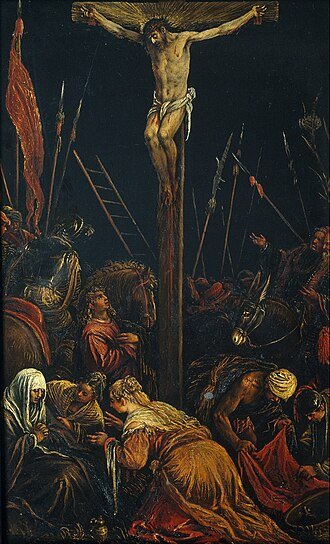
Calvary by Jacopo Bassano, dated 1575, is a large religious painting that places the crucifixion of Jesus of Nazareth in a crowded scene of soldiers, horses and standards. Among the elements shown are a ladder, a halberd and a spear, along with several figures who watch or take part in the moment. Given its monumental format, the work invites the viewer to follow a composition filled with detail.

This canvas by Jacopo Bassano, dated around 1570, depicts the moment when animals board Noah's Ark, as described in the biblical account of the Flood. The scene unfolds in a crowded, lively composition, with many species moving toward the vessel across different planes. It belongs to religious art and is held at the Museo del Prado.

Oil on canvas from 1538 by Jacopo Bassano, treating a religious subject: the Supper at Emmaus, episode from the Gospel of Luke in which the risen Christ reveals himself to two disciples as he breaks bread. Without further documentation available, the reading centers on its subject.

Dated 1552, this painting by Jacopo Bassano belongs to religious art and depicts Jesus of Nazareth on the way to Calvary, the moment he moves toward his crucifixion. It is an oil on canvas held by the Museum of Fine Arts in Budapest. The available sources say little about its commission or composition.

A religious painting depicting the building of Noah's ark, an episode from the biblical story of the Flood. This oil on canvas, dated 1550, is by Jacopo Bassano and is held at the Musée des beaux-arts de Marseille. With the information available, details of its commission and composition cannot be established.

Jacopo Bassano painted this oil on canvas in 1574, a work of religious art depicting Noah's Sacrifice, the Old Testament episode that follows the Flood. The available record offers no further details about its commission, original setting or composition, so any reading of it should remain cautious and rest on its subject and date.

Painted by Jacopo Bassano in 1575, this oil on canvas shows Saint Valentine baptizing Saint Lucilla. Its upright format and large size suggest a work probably meant for a place of worship or prominent display, though its original commission is unknown. The painting is now held in Bassano del Grappa, a town associated with the artist.

Religious painting by Jacopo Bassano, dated 1593 and executed in oil on canvas. The scene gathers the Virgin Mary, Joseph, the infant Jesus and an angel with shepherds, animals and a lamp that lights the group. It is held in the basilica of San Giorgio Maggiore. Without other reference texts, further details about its commission or reception cannot be established.

A religious painting showing the Adoration of the Shepherds, the moment in the Nativity story when shepherds come to pay homage to the newborn child. It is an oil on canvas held by the Gallery of the Academy in Venice. Details about its commission or exact date are not available here.

This religious painting by Jacopo Bassano is dated 1600 and executed in oil on canvas. Available information does not record its title or iconographic details, so the scene rewards close looking at its composition and figures. It is held at the Musée des Beaux-Arts in Carcassonne, where visitors can view it in person.


A religious painting dated 1553 by Jacopo Bassano, executed in oil on canvas. Its records place it in the Galleria Borghese, and it belongs to the Nativity tradition, showing the shepherds' homage to the newborn Christ. With the information available, the original commission and wider context cannot be confirmed in detail.

Painted by Jacopo Bassano in 1590, this oil-on-canvas work belongs to religious art and shows three saints: Saint Roch, Saint Sebastian and Saint Fabian. Little is known about its commission, composition or history, so any reading of the scene should remain tentative. It is held at the Complesso di Santa Caterina.

This 1576 oil on canvas by Jacopo Bassano shows sheep gathered with a lamb, a rural subject in which the artist's attention to animals and country life is easy to see. The available information says nothing about its commission or original setting, so the picture is best read through what it shows: the closeness between the animals, set in a quiet pastoral world.
Where to see the work
- Louvre Museum Paris · 3
- Galleria Borghese Rome · 3
- Gallerie dell'Accademia Venice · 2
- Kunsthistorisches Museum Vienna · 1
- National Gallery London · 1
- Museu Nacional d'Art de Catalunya Barcelona · 1
- Museo del Prado Madrid · 1
- Kimbell Art Museum Fort Worth · 1
- Museum of Fine Arts, Budapest Budapest district XIV · 1
- Musée des beaux-arts de Marseille Marseille · 1
- Sanssouci Picture Gallery Berlin · 1
- Church of San Giorgio Maggiore Venice · 1
- Musée des Beaux-Arts de Carcassonne Carcassonne · 1
- Collection Bemberg Toulouse · 1
- Doge's Palace Venice · 1
- Complesso di santa Caterina Treviso · 1
Curiosities
Titian as a moneychanger
In his painting The Purification of the Temple, Bassano portrayed Titian as a moneychanger. It is usually read as a jab at his colleague, whom he may have wanted to present as greedy. The detail suggests that his relations with other painters of the period were not always friendly, even though he learned a great deal from them.
An altarpiece about a flood
His altarpiece for the church of Santa Maria degli Angeli in Feltre, painted in 1576, depicts the devastating inundation of 1564 known as the Colmeda flood. It was widely understood at the time to have been caused by deforestation and agricultural expansion. The work is a rare example of religious painting that addresses the human impact on the landscape in such an explicit way.