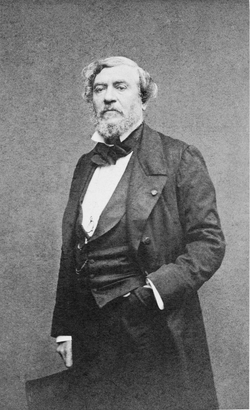
Jean Antoine Théodore Gudin (Paris, 1802 – Boulogne-Billancourt, 1880) was a French painter who specialised in marine art and became one of the leading figures of nineteenth-century seascape painting. Together with Louis-Philippe Crépin, he was named one of the first two official Peintres de la Marine in 1830, and he worked as court painter to both Louis Philippe I and Napoleon III.
He first went to sea, joining the United States Navy in 1819. Back in Paris in 1822, he entered the studio of Anne-Louis Girodet and made his Salon debut the same year. He was commissioned to paint ninety scenes of French naval history for the Palace of Versailles, a huge task that probably took a toll on his health. His works, such as Battle of Ushant or Victory and Death of the Chevalier of Saint Pol, mix Romantic drama with the influence of English marine painting and a striking use of light.
After the fall of the Empire he went into exile in England, and his work fell into obscurity before being rediscovered years later. His daughter, the painter Henriette Gudin, was also among his pupils.
Works (8)
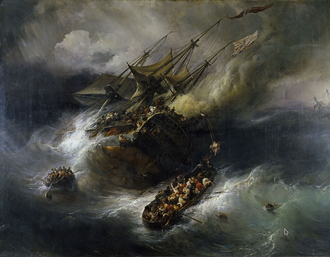

A work by Jean Antoine Théodore de Gudin, a painter known for seascapes, dated 1868 and executed in oil on canvas. Its upright, large format suggests a piece meant to be seen from a distance. The record offers no further details about its commission, its specific scene or its history, so it is best to stick to what is known with confidence: the marine genre and the technique used.


Large history painting that, by its title, shows Napoleon III in Genoa. The scene brings together a ship, a flag, a boat and a lighthouse, placing the action at sea and along the coast. Its horizontal format, nearly five metres wide, opens up the maritime space and makes the harbour the centre of the composition.


Oil on canvas by Jean Antoine Théodore de Gudin, dated 1839, depicting a naval engagement at Ushant in 1778. The record names the warship shown as Glorioso Primero de Junio, a title that does not match the date of the battle, so this detail should be read with caution. The work is held at the Musée national de la Marine in Paris.

Where to see the work
- Musée national de la Marine de Paris Paris · 5
- Musée Léon-Dierx Saint-Denis · 1
- Musée Fabre Montpellier · 1
- Musée des Beaux-Arts de Bordeaux Bordeaux · 1
Teachers and pupils
Studied with
- Anne-Louis Girodet 1767–1824
Pupils
- Antoine Léon Morel-Fatio 1810–1871
- Vilhelm Melbye 1824–1882
- Herminie Gudin 1825–1876
Curiosities
A shipwreck on the Seine
In 1823 Gudin and his older brother Jean-Louis were involved in a shipwreck on the Seine. He escaped, but his brother drowned. The loss affected him deeply for the rest of his life, and it shaped the way he later related to the sea and to his family's memory.
A rescue society in memory of his brother
In 1864 Gudin helped to create the Société centrale de sauvetage des naufragés, and he served as its vice-president. He is said to have founded it in memory of his brother Jean-Louis, who drowned in the Seine shipwreck. A personal tragedy thus led to an organisation devoted to rescuing people in danger at sea.
A young officer who chose to destroy his ship
In 1828 King Charles X commissioned Gudin to paint Ensign Hippolyte Bisson, who the previous year had blown up his ship rather than surrender it to pirates. The commission shows that Gudin's painting was also used to celebrate the courage and sacrifice of French sailors.