
Jean Victor Schnetz
1787–1870 · French academic painter of historical and genre scenes
Jean-Victor Schnetz (Versailles, 1787 – Paris, 1870) was a French academic painter, well regarded for his historical and genre paintings. A pupil of David and a friend of Géricault, he divided his life between France and Italy, a country he had discovered in his youth and to which he remained attached.
His academic career was distinguished. In 1837 he was elected to the Académie des Beaux-Arts, and he directed the French Academy in Rome on two occasions, from 1841 to 1846 and again from 1853 to 1866. His most personal contribution was to treat picturesque, everyday subjects such as Italian peasants and bandits in a classical manner, seeking a balance in the debate between Classicists and Romantics. His works include Two Young Girls Bathing in the Lake of Nemi, in the Louvre, and Combat in front of the Hôtel de Ville de Paris on 28 July 1830, in the Petit Palais.
His legacy survives mainly in French collections, although his paintings also reached museums in Versailles, St. Petersburg and San Francisco.
Works (3)
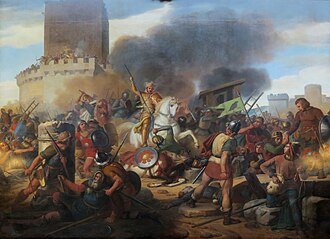
History painting from 1835 showing Count Eudes in armour and helmet, crowned, on horseback beside a soldier before the fortifications of Paris. The large canvas and solemn tone give the scene a heroic character, evoking the city's defence. Its monumental format is typical of nineteenth-century French history painting.

History painting by Jean Victor Schnetz, dated 1826, whose subject is listed as Boethius imprisoned. The scene gathers a woman, a child, an elderly figure and a dog, suggesting a family setting within confinement. Without further documentation, it is safest to read it cautiously: the theme seems to turn on the contrast between captivity and the human bonds surrounding it.

This large 1833 canvas depicts the second day of the July Revolution of 1830, when Parisians raised barricades and seized the Hôtel de Ville in protest against the repressive decrees of Charles X. Schnetz focuses on a young student climbing the barricade, bayonet raised, beside a working-class boy who dies holding the tricolour, much like Victor Hugo's Gavroche. Fighters from every social class gather around them. Unlike the forward-surging figures of Delacroix, Schnetz's combatants stay within the composition, and several young boys, echoing Joseph Bara, add a note of fragility.
Where to see the work
- Musée de l'Histoire de France Versailles · 1
- Louvre Museum Paris · 1
- Musée des Beaux-Arts de la ville de Paris Paris · 1
Curiosities
Works spread across the world
Sources list works by Schnetz in very different places: the Louvre and the Petit Palais in Paris, the Château de Versailles, the Hermitage in St. Petersburg and the Museum of Fine Arts in San Francisco. That a painter whose career unfolded almost entirely in France has pictures on the Pacific coast and on the Neva shows how widely academic nineteenth-century works reached collectors and institutions around the world.
Honours across four decades
Schnetz was made a Chevalier of the Legion of Honor in 1825 and raised to Commander in 1866, the same year his second term as director of the French Academy in Rome ended. The two distinctions are more than forty years apart, an interval that reflects the length of his public career within French artistic institutions.