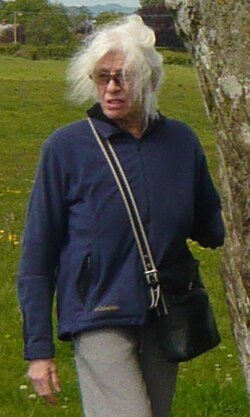
Jo Baer
1929–2025 · American painter associated with Minimalism
Jo Baer (Josephine Gail Kleinberg, Seattle, August 7, 1929 – January 21, 2025) was an American painter associated with Minimalist art. Her work falls into two distinct phases: non-objective painting in the 1960s and, from the mid-1970s, a non-narrative figuration that she once called "radical figuration." She lived and worked in Amsterdam, in the Netherlands.
She studied biology at the University of Washington, partly at her mother's urging, since her mother wanted her to become a medical illustrator, and later took graduate coursework in psychology in New York. After a brief marriage and a period in Los Angeles, she settled in New York in 1960 and remained there until 1975. That year she had rejected Abstract Expressionism in favor of hard-edge non-objective painting, a style she developed through the 1960s into increasingly pared-down formats.
Her first one-person show took place in 1966 at the Fischbach Gallery in New York, and that same year she appeared in "Systemic Painting" at the Solomon R. Guggenheim Museum and in "10" at the Virginia Dwan Gallery. Among her key series are the Korean series (1962), with dominant white fields enclosed by bands of sky blue and black, and The Stations of the Spectrum (1967–1969), which led to the Wraparound paintings, where thick bands of color continued around the sides of the canvas. She was concerned with what happens at edges, and this interest in visual perception also runs through her writings, such as "Art & Vision: Mach Bands" (1970).
In 1975 the Whitney Museum of American Art held a retrospective of her work, but that same year she moved to Smarmore Castle, in County Louth, Ireland. Her legacy lies in defending painting against Minimalist sculptors who considered it obsolete, and in questioning the prevailing tenets of Minimalism from within the movement.