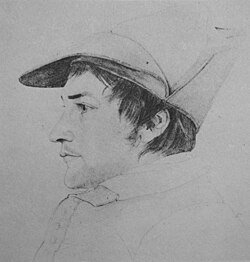
Johann Anton Ramboux
1790–1866 · German painter and lithographer from Trier
Johann Anton Ramboux (Trier, 1790 – Cologne, 1866) was a German painter and lithographer best known for his watercolors of Trier and the Moselle valley, as well as copies of Renaissance painting in Italy. His training took him through France and Italy, and his topographical record of the region remains valuable.
The son of a father from Savoy and a mother from a family of goldsmiths, he first attracted notice at the Bürgerschule in Trier, where his drawing teacher Christoph Hawich recommended him for further study. He trained with Jean-Henri Gilson in Florenville, then with Jacques-Louis David in Paris until 1812. He was admitted to the Royal Academy of Fine Arts in 1815, and from 1816 to 1822 lived in Rome, where he met painters associated with the Nazarene movement.
Back in Trier for about a decade, he produced hundreds of watercolors of the city and the Moselle, which he began reproducing as lithographs in 1825. That venture ended in 1827. From 1832 he spent another decade in Italy, painting landscapes and folk scenes and copying Renaissance frescoes and mosaics. In 1844 he took up the post of curator of the Wallraf Collection in Cologne, on the recommendation of Johann Gottfried Schadow. After a pilgrimage to Jerusalem, he was named the first honorary citizen of Trier in 1858.
His legacy lies chiefly in his topographical views and copies of older works, which preserve records of buildings and paintings now lost or altered. Since 1961 the city of Trier has awarded the Ramboux Prize to young artists.
Works (1)
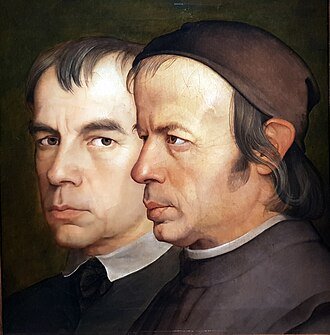
Where to see the work
- Wallraf–Richartz Museum Cologne · 1